
Legislative News
There is only one legislative update since the March 2026 Legislative News blog. We reported that on March 23, 2026, California’s “AB-2497 Physical therapists,” an act amending the California Physical Therapy Act, was referred to the Assembly Business and Professions Committee. The Bill is slowly moving through the legislative process, and a few sections have been modified. The clause that physical therapists would be able to prescribe nonopioid analgesic and nonsteroidal anti-inflammatory medications has been removed. Clause 2620.5 has been modified:
“The practice of physical therapy includes the use of electrode needles and solid filiform needles to perform tissue penetration for the purpose of evaluating and interpreting performance and treating the neuromusculoskeletal system.(b) This section shall not be construed to authorize the practice of the art and science of acupuncture, as described in Section 4926 and as taught in acupuncture schools under Section 4927.5.“
On April 22, 2026, AB 2497 (Modernization of Physical Therapy Practice Act) passed the Assembly Business and Professions Committee 10-8-1. The bill will be heard in the Assembly Appropriations Committee in May.
Since there are no recent developments regarding legislative issues, bill proposals, or expansions of the dry needling scope of practice, this blog will focus on why overlap in healthcare practice is necessary.
Understanding Scope of Practice and Overlap
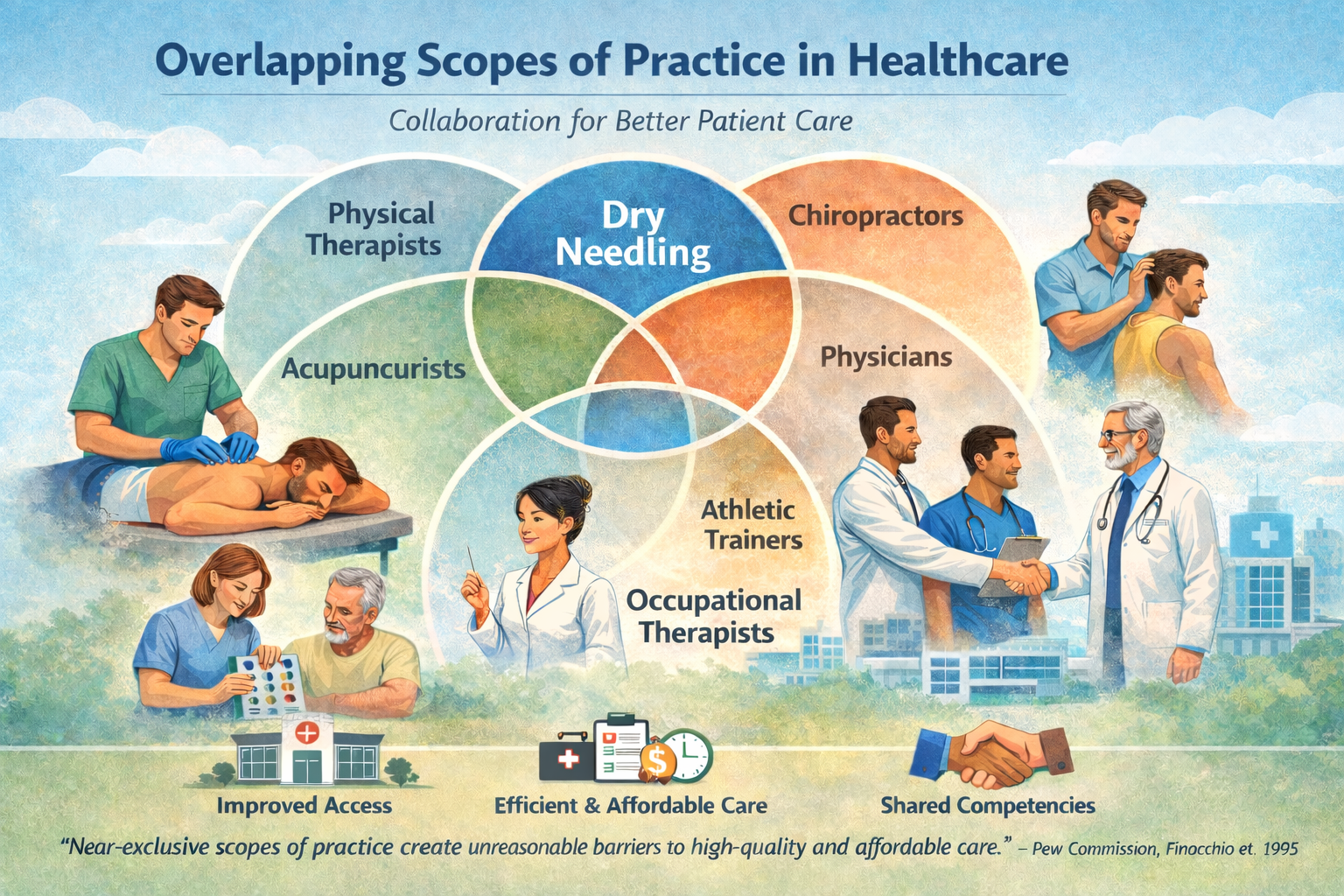
Modern healthcare is not a collection of isolated silos—it is an interconnected system that depends on collaboration, shared knowledge, and, importantly, overlap in scope of practice. While professional boundaries are essential for safety and accountability, overly rigid divisions between disciplines can create barriers to care. The ongoing debate surrounding dry needling provides a clear and timely example of why overlap is not only inevitable but necessary.
Scope of practice is generally defined as the activities that a healthcare provider is educated, trained, and legally authorized to perform in patient care. The Federation of State Medical Boards of the United States describes it as “those health care services a physician or other health care practitioner is authorized to perform by virtue of professional license, registration, or certification.”
Crucially, the Federation also emphasizes that healthcare is inherently collaborative. It notes that “the concept of collaboration acknowledges that scopes of practice often overlap within the health care delivery system,” and that such overlap “can be an effective means for providing safe and competent health care.” This perspective is widely supported across disciplines. Overlap is recognized in:
- Psychology and clinical social work
- Physical therapy and occupational therapy
- Chiropractic and physical therapy
- Acupuncture and physical therapy
- Medicine and other health professions
In other words, overlap is not an exception—it is a foundational characteristic of a functioning healthcare system.
The Cost of Exclusivity
The risks of restricting scope of practice too tightly have been recognized for decades. The Pew Health Commission Taskforce on Health Care Workforce Regulation concluded that near-exclusive scopes of practice create unreasonable barriers to high-quality and affordable care (Finocchio et al., 1995). This finding remains highly relevant today. When professions claim exclusive rights to specific techniques or interventions, the consequences often include:
- Reduced access to care
- Increased healthcare costs
- Delays in treatment
- Fragmentation of services
Rather than protecting patients, excessive exclusivity can inadvertently harm them.
Dry Needling: A Modern Case Study
Dry needling is commonly performed by physical therapists, athletic trainers, acupuncturists, and other rehabilitation professionals as part of a broader treatment plan. However, because it involves needles, it has been the subject of opposition from some acupuncture organizations, who argue that needling techniques should fall exclusively within their domain. As recently as 2025, acupuncture groups in Georgia and Massachusetts introduced legislation to limit dry needling by physical therapists.
This raises a critical question:
Should the use of a tool define ownership of a treatment—or should competency and clinical context matter more?
Why Overlap Improves Patient Care
1. Better Access and Efficiency
Healthcare systems are under increasing strain due to rising demand and workforce shortages. Allowing multiple qualified professionals to perform similar interventions expands access and reduces delays.
For example, a patient undergoing physical therapy for chronic neck pain may benefit from dry needling during the same session. Requiring referral to a separate provider introduces additional appointments, increased costs, and interruptions in care. Overlap eliminates these inefficiencies.
2. Integrated, Patient-Centered Treatment
Patients do not experience their conditions in disciplinary categories. They experience pain, limitation, and dysfunction. Physical therapists, for instance, integrate exercise therapy, manual techniques, neuromuscular training, pain science education, and modalities like dry needling.
Removing one component from their scope limits their ability to deliver comprehensive, individualized care. Overlap enables clinicians to treat the whole patient—not just isolated aspects of their condition.
3. Competency Over Professional Boundaries
A key principle in modern healthcare is that competency—not professional title—should determine scope. Different professions may arrive at similar interventions through different training pathways:
- Physical therapists approach dry needling through anatomy, biomechanics, and pain science
- Traditional Chinese Acupuncturists approach needling through Chinese medicine frameworks
These differences do not negate competency. Instead, they reflect the diversity of perspectives that enrich healthcare. As the Federation of State Medical Boards recognizes, shared competencies across professions can support safe and effective collaboration.
Addressing Opposition to Overlap
Opposition to overlap—such as resistance from some acupuncture groups regarding dry needling—sometimes stems from legitimate concerns, but in other cases, fear of loss of patients may set the agenda. These include safety, training standards, and professional identity, which are best addressed through regulation and collaboration rather than exclusion. State Boards are responsible for protecting the public through implementing legislation and developing rules. Patient safety is paramount, and state boards ensure safety through standardized education requirements, competency-based training, and clear regulatory oversight.
Healthcare professions naturally seek to protect their identity and expertise. However, when professional boundaries conflict with patient access, priorities must be reassessed. The goal of healthcare regulation is not to preserve professional territories—it is to optimize patient outcomes.
The Bigger Picture: A Collaborative Healthcare System
The recognition of overlap across disciplines—from psychology and clinical social work to physical therapy and acupuncture—underscores a central truth that healthcare works best when professionals collaborate, not compete.
The Pew Health Commission Taskforce on Health Care Workforce Regulation highlighted the dangers of exclusivity decades ago, and the Federation of State Medical Boards of the United States continues to affirm that overlapping scopes of practice can enhance care delivery.
Dry needling is simply one example of a broader principle. The same dynamics apply to:
- Prescriptive authority among providers, i.e., in California, a bill proposes to expand the scope of practice of a physical therapist to include the authority to prescribe nonopioid analgesic and nonsteroidal anti-inflammatory medications
- Diagnostic responsibilities across disciplines: an increasing number of physical therapists are being trained in MSK Ultrasound, but they generally are not yet allowed to make a diagnosis of a partial muscle tear or tendinopathy.
- Therapeutic interventions are shared between professions, such as dry needling, spinal manipulation, and therapeutic exercise.
In each case, thoughtful overlap improves flexibility, access, and efficiency.
Conclusion
The debate over dry needling is not just about a technique—it is about how healthcare systems are structured. Overlap in scope of practice is not a weakness to be eliminated, but a strength to be managed responsibly. When multiple qualified professionals can safely provide a treatment:
- Patients benefit from improved access
- Systems operate more efficiently
- Care becomes more integrated and effective
Efforts to restrict overlap in the name of exclusivity risk creating the very barriers that healthcare reform has long sought to remove. A modern, patient-centered healthcare system must embrace a simple principle:
What matters most is not who owns a technique—but who can deliver it safely, effectively, and in the best interest of the patient.
Jan Dommerholt, PT, DPT – President/CEO of Myopain Seminars
A few references
Federation of State Medical Boards of the United States, 2005. Assessing scope of practice in health care delivery: Critical questions in assuring public access and safety. Federation of State Medical Boards of the United States
Finocchio L.J., Dower C.M., McMahon T., Gragnola C.M., Taskforce on Health Care Workforce Regulation. 1995. Reforming Health Care Workforce Regulation: Policy Considerations for the 21st Century. Pew Health Professions Commission, San Francisco