
California
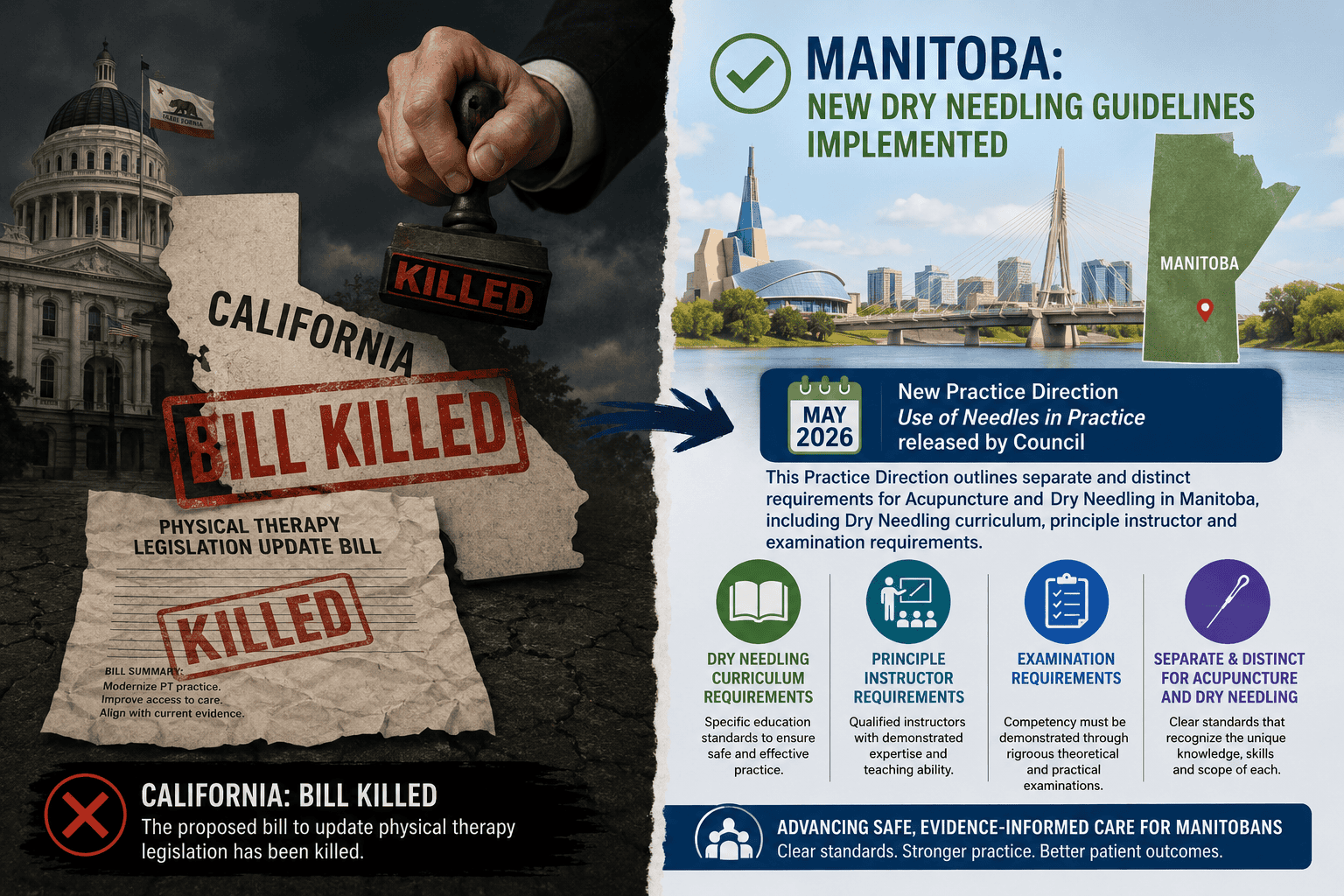
As we reported in the May 2026 Legislative Update, the California Assembly Appropriations Committee removed dry needling from Bill AB 2497 (Modernization of the California PT Practice Act), which would have seemed to clear the way for the bill to be approved and enacted into law. One of the main remaining points in the Bill was to remove the antiquated requirement that California physical therapists obtain physician approval to see patients beyond the initial 12 PT visits or 45 days.
California State Assembly Member Natasha Johnson asked to approve the bill after dry needing had been removed:
If you have never watched the kind of debates that take place in government halls, let’s have a look at some of the arguments against a bill that does not include dry needling………
Surprisingly, although dry needling had already been removed, several legislators continued to oppose the bill because of it. California State Assembly Member Alex Lee opposed the bill because of “scope encroachment” and “cultural encroachment.” According to Mr. Lee, the bill started as an encroachment of acupuncture, which he described as a “field dominant in Eastern Chinese Medicine.” He argued that “over the years, there have been attempts to try to appropriate Chinese culture and Chinese medicine into dry needling:”
California State Assembly Member Al Muratsuchi, also opposed the bill because the bill is “disrespecting 3,000 years of traditional Chinese acupuncture medicine, and for that reason, I will be opposing the bill:”
California State Assembly Member Mike Fong opposed the bill in response to lobbying by his acupuncturist constituents:
California State Assembly Member Jessica Caloza also expressed that many members of the Asian American community continued to have concerns:
After hearing these flawed arguments, all focused on dry needling, Assembly Member Johnson reiterated the point one more time. Once again, DN was no longer part of the bill!
The bill did not get approved.
This brief civic lesson illustrates the absurd, completely irrelevant arguments some legislators use to justify their decisions. It also illustrates that Oscar Gallardo, PT, DPT, President of the California Physical Therapy Association, was right when he placed part of the responsibility on the lack of involvement among California physical therapists. According to Dr. Gallardo, “opposition groups, particularly the acupuncture community, organized a highly visible and aggressive advocacy campaign against the provision. They attended hearings in force, met directly with legislators and staff, and maintained sustained pressure throughout the process.”
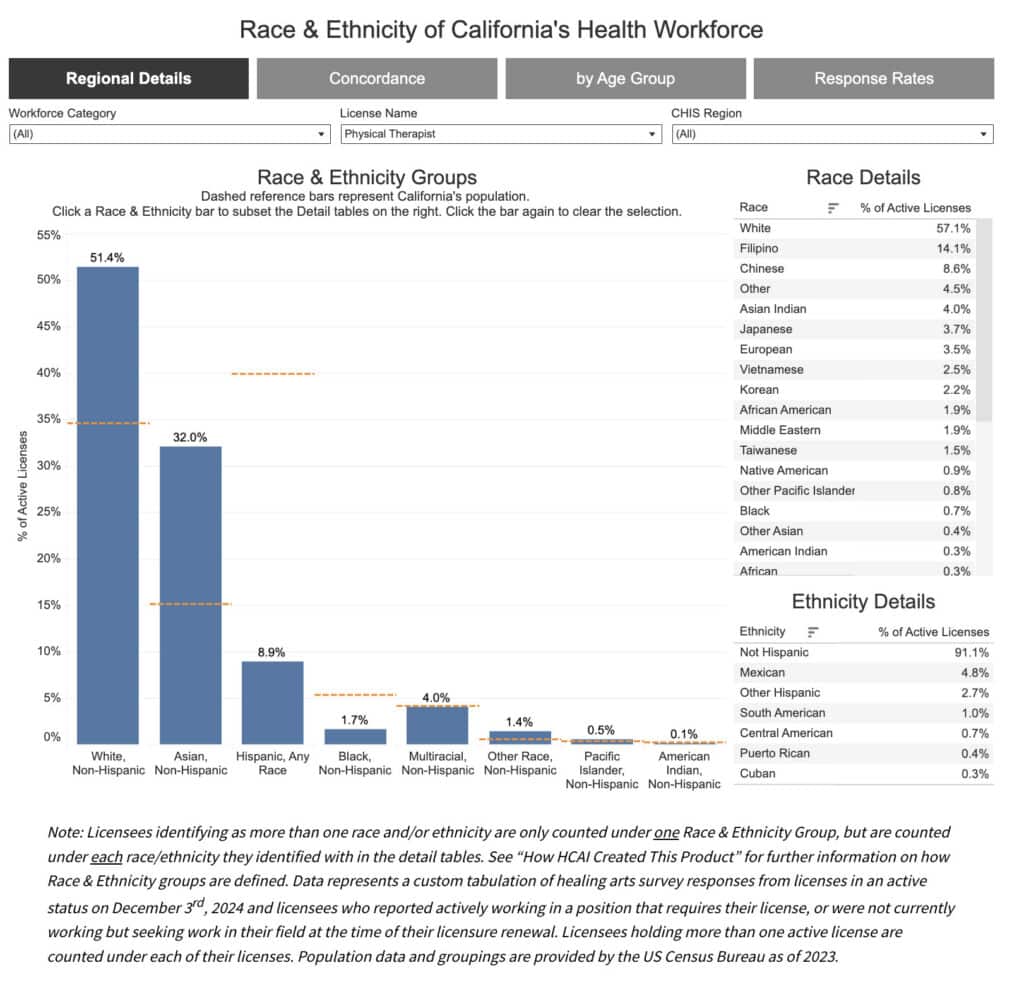
The California Physical Therapy Association seemed surprised that the argument of cultural encroachment was raised during the debates, even though similar arguments were raised in Washington State. If and when dry needling is reintroduced to California legislators, proponents should consider the argument of cultural encroachment, defined as “the adoption or exploitation of another culture by the more dominant culture.” In other words, Assembly Member Lee implied that physical therapists would exploit “Eastern Chinese culture.” Interestingly, 51.4% of physical therapists in California are White/Non-Hispanic and 32% are Asian/Non-Hispanic.
Looking at the race and ethnicity of acupuncturists in California, 58.7% are Asian/Non-Hispanic and 31.9% are White/Non-Hispanic.
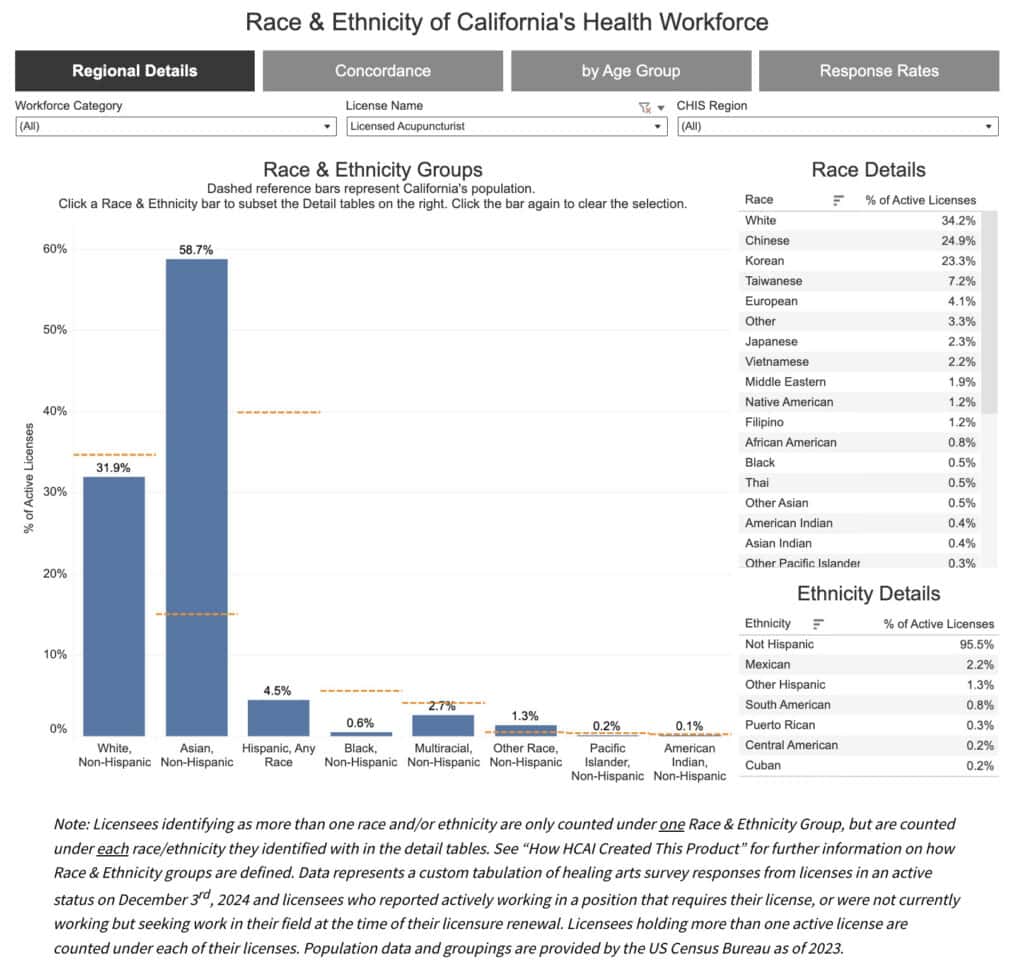
Does this look like cultural encroachment? The argument becomes even more dubious when you consider that dry needling originated with Dr. Janet Travell, which does not suggest that similar approaches did not already exist within acupuncture, but it does not support the notion of cultural encroachment.
Manitoba
The Manitoba Centre for Professional Regulatory Collaboration issued an update on “the Dry Needling roster requirements,” which will come into effect on December 1, 2026, for registered physiotherapists in Manitoba.
In Manitoba, physiotherapists are allowed to use acupuncture if they have successfully completed a 100-hour educational acupuncture training program. Acupuncture is a so-called” rostered activity” in Manitoba, which means that physiotherapists who wish to perform acupuncture as part of their physiotherapy practice must • be registered with the College of Physiotherapists in Manitoba (CPM). Physiotherapists could practice Dry Needling only if on the Acupuncture roster with specific additionally training in dry needling and practiced within their knowledge skills and abilities.
In May 2026, a new Practice Direction Use of Needles in Practice was released by Council, which outlines separate and distinct requirements for Acupuncture and Dry Needling in Manitoba that includes Dry Needling curriculum, principle instructor, and examination requirements.
The College published the following FAQ:
Are physiotherapists who are NOT currently trained in Acupuncture permitted to start a dry needling course prior to December 1, 2026?
The College cannot limit a registrant from taking a course. However, as with any course involving a high-risk act, a physiotherapist can only practice the skill within the course setting. The physiotherapist cannot practice on the public or incorporate dry needling into their practice until they have applied for the roster and received communication from the College that they were approved and have had their name entered on the Dry Needling roster after December 1, 2026.
Is there a plan to formalize a process to approve limited dry needling practice for participants between course weekends/sessions in the future?
No. A physiotherapist must complete all coursework related to the roster requirements, apply and have their name confirmed as entered on the roster by the College before they can practice Dry Needling outside of the course setting. As the Dry Needling roster requirements no longer requires previous needling exposure by requiring a registrant to be rostered in Acupuncture first, this option to allow limited practice between course sessions is not allowed and is not being considered.
If a course provider feels their Dry Needling course(s) meets the College of Physiotherapists of Manitoba roster requirements, can they advertise this to future course attendees?
No. The College does not endorse or approve courses, so an educator cannot imply that their offering aligns with the College in any way. The roster requirements are fluid and will be reviewed and may be edited by Council regularly, so it would not be accurate to promote a course as meeting the roster requirements.
In addition, in Manitoba, it is a registrant’s responsibility to show that the course(s) taken meets the requirements. They must outline how the course met the specific requirements from the Practice Direction. Simply stating a certain course was taken would not be accurate or accepted.
If a physiotherapist took course(s) to practice Dry Needling in another province and they move to Manitoba, will their ability to practice in another jurisdiction be recognized?
The ability to practice Dry Needling alone in another jurisdiction will not be adequate to be rostered in Manitoba. A physiotherapist moving to Manitoba who wants to practice Dry Needling will need to meet the roster requirements outlined in the Practice Direction. They will not be able to be rostered or practice in Manitoba until they have applied for and been approved for the roster.
What are the examination requirements for Dry Needling and do these differ from Acupuncture?
To be rostered, a physiotherapist will need to show evidence that the course taken includes a formal written and practical examination to assess competency and has accrued a minimum of 75 hours of instructor interaction and evaluation with a minimum of 30% of those hours being direct contact hours. The registrant must provide details on the format of the testing. Overall, the evaluation must allow for objective assessment of the attendee’s theoretical knowledge of the course content and practical dry needling skills.
Unlike Acupuncture, there is no requirement for an external examiner (a person not involved in teaching the course completing the evaluation process).