
Two Systems, Similar Challenges, and an Opportunity for Reform
Introduction
Dry needling has become an increasingly established intervention within contemporary physical therapy practice. As we have summarized in a previous blog, despite its growing clinical use, the regulatory frameworks governing dry needling remain remarkably inconsistent—not only internationally, but also among individual states and territories (USA) and provinces (Canada).
Two important studies published in 2026 by Nadine Crocker and Eric Parent confirm our previous findings and offer another opportunity to examine these regulatory issues. Their environmental scans of dry needling regulations in Canada and the United States highlight substantial differences in how jurisdictions authorize dry needling, establish educational requirements, assess professional competence, and oversee patient safety. Together, these publications raise a fundamental question: Should dry needling regulation be determined primarily by geographic boundaries, or guided by a consistent, evidence-informed framework of professional competencies and patient safety?
A Shared Regulatory Structure but Different Approaches
Both Canada and the United States rely on decentralized systems of professional regulation. Neither country has a single national licensing authority that establishes legally binding dry needling requirements for all physical therapists.
In the United States, the Federation of State Boards of Physical Therapy (FSBPT) attempted to address this issue through “ProCert,” a nationwide dry needling certification system, but it was not legally binding. For only a few months, Myopain Seminars qualified as a certified dry needling course provider through ProCert, because the program was canceled shortly after it was released.

In Canada, provincial and territorial legislation establishes the legal framework for physiotherapy practice. Provincial regulatory colleges and other responsible authorities establish and enforce professional standards, including requirements for restricted activities such as dry needling.
In the United States, physical therapy is regulated primarily through state practice acts, administrative rules, and decisions by licensing, regulatory, and occasionally educational boards. The District of Columbia and U.S. territories add further regulatory jurisdictions. In general, state legislatures determine statutory scope-of-practice provisions, while regulatory boards interpret and implement the law within their delegated authority.
The two countries therefore share a fundamental characteristic: Professional competence is broadly recognized as essential, but the requirements for establishing and demonstrating that competence vary considerably by jurisdiction.
This decentralization permits local regulatory authorities to respond to emerging clinical practices, accommodate regional circumstances, and develop requirements suited to their professional environments. However, it also produces fragmentation. A physical therapist may be considered sufficiently trained and competent to perform dry needling in one jurisdiction but be prohibited from performing the same intervention in another. Geographic differences in legal authorization do not necessarily reflect differences in clinical competence.
What the 2026 Studies Reveal
Crocker and Parent used environmental scanning methods to examine regulatory requirements, including legislation, policies, prerequisites, approved courses, educational content, minimum instructional hours, registration, and continuing competency. Their findings show considerable variation between the two countries.
United States regulatory jurisdictions
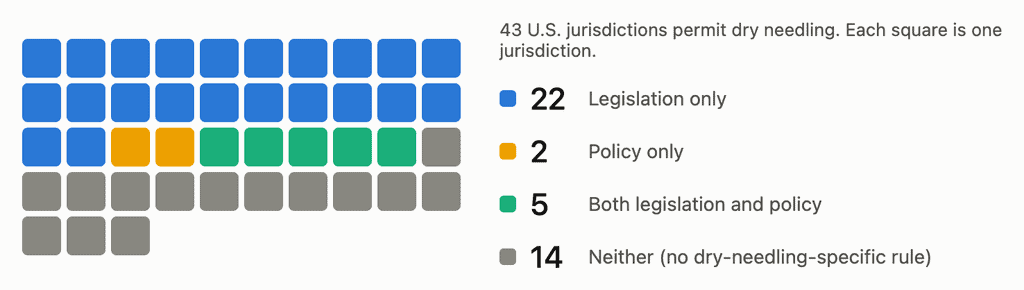
Of 56 regulatory jurisdictions, 43 permit dry needling, 5 prohibit it, and 8 are silent on it.
The Canadian study found that seven jurisdictions used both legislation and professional standards, two relied on legislation, and one on standards alone. The study found no identified dry-needling-specific oversight in three jurisdictions.
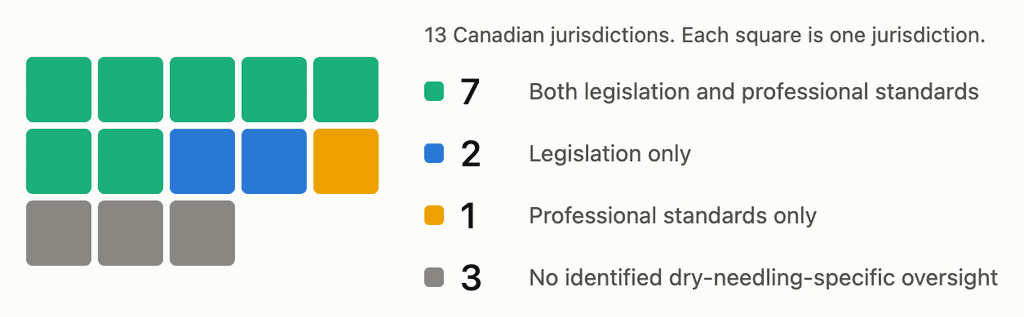
Importantly, the absence of dry-needling-specific regulation should not automatically be interpreted as the absence of general professional accountability.
Comparing educational and regulatory requirements
| Regulatory feature | United States | Canada |
| Jurisdictions permitting or regulating DN in the respective analyses | 43 | 10 |
| Approved course requirements or processes | 24 | 4 |
| Specific course content required | 22 | 9 |
| Minimum instructional hours required | 21 | 3 |
| Clinical experience or course prerequisites | 11 | 3 |
| Registration or rostering systems | 4 | 9 |
| Specific mandated continuing DN education | 1 | 0 |
The Canadian prerequisites category includes requirements other than years of clinical experience. The United States has more jurisdictions that prescribe minimum educational hours or establish course approval processes. Canada, by contrast, relies more on registration or rostering requirements in jurisdictions with identified dry needling regulation. Neither approach, however, consistently establishes that a practitioner has achieved and maintained the competencies required for safe clinical practice.
The United States
The American regulatory system is strongly influenced by the relationship between legislatures, professional licensing boards, and competing healthcare professions.
Advantages
- Professional regulators can focus directly on public protection. Regulatory state boards have an explicit public-protection mandate. This provides an institutional basis for evaluating dry needling according to safety, competency, and professional accountability.
- Legislative processes provide opportunities for public participation. Proposed scope-of-practice changes may involve hearings, expert testimony, stakeholder consultation, and legislative debate.
- These mechanisms can increase transparency and accountability.
- Clear statutory recognition can strengthen professional legitimacy. When a physical therapy practice act explicitly includes dry needling, the profession gains a more secure legal foundation for the intervention. This may reduce uncertainty for practitioners, employers, insurers, and patients.
- States can develop different educational and competency requirements. Successful approaches may subsequently inform policy development elsewhere.
- National professional resources can support local decision-making. In 2024, the Healthcare Regulatory Research Institute (HRRI), in partnership with the Federation of State Boards of Physical Therapists (FSBPT) and the Human Resources Research Organization (HumRRO), conducted an updated study of dry needling competencies resulting in the publication of the “Dry Needling Competency Update: Report Memo 2024.″ In theory, state boards and legislatures could use the assessment to create more consistent standards without requiring every jurisdiction to develop an entirely new competency framework. However, few, if any, state boards appeared to have used the competency analysis.
Disadvantages
- Professional scope can become a political rather than a scientific question. Legislative decisions are not determined exclusively by clinical evidence or professional competency. Organized professional opposition, lobbying, political relationships, and competing interpretations of scope of practice can influence the process, which creates the possibility that authorization will depend partly on political circumstances rather than a consistent assessment of the intervention’s safety and the practitioner’s qualifications.
- Legislation may not keep pace with clinical developments. Statutory definitions can become outdated as professional education, technology, and treatment techniques evolve. Amending legislation can be time-consuming and expensive.
- Regulatory silence creates uncertainty. The eight jurisdictions classified as silent in the U.S. environmental scan illustrate an important problem. Silence should not automatically be interpreted as permission or prohibition. Practitioners may need additional legal or regulatory clarification.
- Educational requirements may be arbitrary. Different states prescribe different training durations, clinical experience prerequisites, and approved courses. A numerical requirement does not establish scientific justification. A 100-hour course is not inherently superior to a 50-hour course simply because it is longer. Course content, instructor qualifications, supervised clinical experience, assessment methods, and demonstrated competencies are potentially more meaningful indicators of educational quality.
The fundamental weakness of the American approach is therefore not decentralization itself, but the possibility that legal authorization and professional competence become disconnected.
Canada
Canada’s system places considerable responsibility on provincial physiotherapy regulators to establish professional standards within their statutory authority.
Advantages
- Professional regulators can focus directly on public protection. Regulatory colleges have an explicit public-protection mandate. This provides an institutional basis for evaluating dry needling according to safety, competency, and professional accountability.
- Practice standards may be more adaptable than legislation. Where the law delegates appropriate authority, colleges can revise educational and clinical requirements without necessarily requiring a new legislative debate.
- Registration and rostering improve transparency. The study found registration or rostering requirements in nine Canadian regulatory colleges, which may facilitate oversight and help identify practitioners with documented qualifications.
- Course approval systems can establish educational expectations. British Columbia, Saskatchewan, Quebec, and Yukon maintained approved course lists. British Columbia was particularly notable for having formal criteria for evaluating dry needling courses.
Disadvantages
- Regulatory inconsistency remains substantial. Despite operating within one national healthcare environment, Canadian provinces and territories differ considerably in their prerequisites, course approval systems, educational requirements, and oversight mechanisms.
- Approved course lists can restrict educational choice. When regulators approve specific courses or providers, practitioners may have fewer educational options. Such systems may inadvertently favor established providers, particularly if approval criteria are not transparent, evidence-informed, and accessible to qualified new providers.
- Professional experience requirements may lack sufficient justification. British Columbia’s requirement of two years and 3,900 hours of physiotherapy practice illustrates this issue. Clinical experience can contribute to sound judgment, but years in practice do not necessarily establish competence in a particular intervention.
- Professional self-regulation does not guarantee evidence-based standards. Crocker and Parent found that no Canadian regulatory college met all six recommendations used in their evaluation. Furthermore, none had established a standardized serious adverse event reporting system, and none mandated specific continuing dry needling competency requirements. Public protection depends on more than establishing requirements before a clinician begins performing an intervention.
The Educational Hours Paradox
One of the most consequential issues raised by both publications concerns the relationship between educational hours and professional competence. The Canadian study identified minimum requirements of 90 hours in Saskatchewan, 100 hours in British Columbia, and 102 hours in Quebec. In the United States, 21 jurisdictions prescribed minimum instructional hours, with considerable variation. But what scientific justification supports a particular number?
Crocker and Parent highlight the FSBPT’s 2015 competency analysis, which concluded that approximately 86% of the competencies identified for dry needling were already addressed in entry-level physical therapy education. The 2024 update raised that figure to 88%. However, this does not imply that physical therapists are automatically competent to perform dry needling upon graduation. It does suggest that postgraduate education should build on established professional knowledge rather than unnecessarily repeat foundational competencies. Physical therapists already receive substantial education in anatomy, physiology, pathology, clinical examination, differential diagnosis, infection prevention, and patient management. Postgraduate dry needling education should integrate this foundation with intervention-specific knowledge and psychomotor skills.
An educational framework should therefore prioritize demonstrated competence in patient selection, relevant regional anatomy, safe needle handling, clinical reasoning, informed consent, complication recognition, and emergency procedures. Instructional hours can serve as an administrative benchmark, but they are an imperfect surrogate for competence. Neither study establishes that longer mandatory courses produce fewer adverse events or better clinical outcomes. The central regulatory question should not be how many hours a physical therapist has attended, but whether the therapist can demonstrate the knowledge, judgment, and practical skills necessary to perform dry needling safely.
Patient Safety
Dry needling is an invasive intervention, and although serious adverse events appear uncommon, complications can occur. Both studies identify pneumothorax, nerve injury, vascular injury, infection, and other potentially serious complications as relevant safety concerns. The authors also discuss limitations in adverse event reporting, including inconsistent definitions, possible underreporting, and difficulties establishing accurate incidence estimates, which presents a substantial regulatory challenge.
Regulators frequently establish detailed educational prerequisites, yet comparatively little attention appears to be directed toward systematically measuring what happens after practitioners enter clinical practice. A competency-based regulatory framework should include mechanisms to monitor adverse events, examine patterns of preventable harm, and revise educational expectations accordingly. For example, standardized reporting could help determine whether complications are associated with anatomical regions, techniques, training backgrounds, or practitioner experience levels, providing a stronger empirical foundation for regulatory decisions than relying exclusively on expert consensus.
The environmental scans identify regulatory gaps, but they do not show that jurisdictions with fewer requirements experience more adverse events. The U.S. study explicitly acknowledges the absence of empirical evidence establishing that implementing regulatory requirements improves safety. Consequently, recommendations for stronger oversight should be treated as reasonable public-protection proposals requiring evaluation, rather than as interventions already proven to reduce harm.
Comparing the Regulatory Processes
| Dimension | United States | Canada |
| Primary decision-makers | State legislatures and licensing boards | Provincial or territorial governments and professional regulators |
| Principal strength | Explicit legal recognition and public legislative scrutiny | Professional standards and administrative flexibility |
| Principal weakness | Potential politicization and statutory rigidity | Inconsistent college requirements and possible administrative barriers |
| Education oversight | More jurisdictions specify hours or course approval | Selected colleges maintain approved course lists |
| Practitioner identification | Relatively uncommon DN-specific rostering | Widespread rostering among regulating colleges |
| Shared limitation | Insufficient evidence linking regulatory requirements to improved safety | Insufficient evidence linking regulatory requirements to improved safety |
The comparison suggests that neither system is categorically superior. The United States offers opportunities for explicit legislative recognition, while Canada demonstrates the potential advantages of professionally administered standards and practitioner registration. Both systems, however, risk emphasizing procedural compliance rather than measurable clinical competence.
Toward a North American Framework for Dry Needling Regulation
Crocker and Parent’s findings support considering a more coordinated approach. A common framework need not eliminate state or provincial autonomy. Instead, it could establish shared principles that jurisdictions adapt to their legal systems.
Six priorities deserve consideration:
1. Competency-based education: Establish core knowledge, clinical reasoning, and practical skills required for safe dry needling, using the FSBPT competency analysis and other relevant evidence as starting points.
2. Transparent course evaluation: Assess educational programs against published criteria that address safety, clinical competence, instructor qualifications, and practical assessment—not merely instructional hours or provider identity.
3. Proportionate prerequisites: Require prior clinical experience only when evidence or a defensible risk assessment supports it, rather than assuming that additional years in practice automatically improve dry needling safety.
4. Ongoing competence: Develop reasonable mechanisms for maintaining clinical skills, particularly among practitioners who perform dry needling infrequently or use higher-risk techniques.
5. Standardized adverse event reporting: Establish consistent definitions, confidential or appropriately protected reporting pathways, and methods for analyzing preventable complications.
6. Meaningful informed consent: Ensure patients receive understandable information about the intervention’s rationale, expected benefits, alternatives, material risks, and their right to decline treatment.
Evaluate these proposals for feasibility, effectiveness, administrative burden, and unintended consequences. More regulation is not automatically better regulation. Indeed, unnecessary barriers can increase educational costs, reduce access to competent providers, and discourage professional innovation without producing corresponding safety benefits. The objective should be proportionate regulation: sufficient oversight to protect patients without imposing evidence-unsupported restrictions.
Limitations of the Evidence
Although the two studies provide valuable comparative information, several limitations warrant consideration. Both were environmental scans rather than prospective evaluations of regulatory effectiveness. They primarily documented publicly available requirements, supplemented by communication with regulatory authorities.
The findings therefore establish considerable regulatory heterogeneity and identify potential gaps. They do not establish which country’s system produces safer clinicians or better patient outcomes, which should remain central to any interpretation of the research.
Conclusion
The United States and Canada have developed different approaches to regulating dry needling, but both face remarkably similar challenges.
The American system can provide explicit statutory authorization and public accountability, yet its legislative processes may be influenced by professional competition and political considerations. The Canadian system offers opportunities for flexible, professionally administered oversight, yet it also produces inconsistent requirements and potential barriers to educational access. Neither system has established a uniformly applied, empirically validated framework linking educational requirements, practitioner competence, regulatory oversight, and patient safety. Crocker and Parent’s two studies contribute by documenting these differences and providing a foundation for further discussion.
The next step should move beyond cataloging regulatory requirements toward examining their actual effects. Do mandatory instructional hours improve safety? Do approved course lists produce more competent practitioners? Does prior clinical experience reduce complications? Can standardized adverse event reporting identify deficiencies that traditional regulatory approaches overlook? These are empirical questions that deserve empirical answers.
Ultimately, the legitimacy of professional regulation does not rest on the number of rules imposed, the profession that historically used a technique, or the jurisdiction in which a clinician practices, but on whether the regulatory framework meaningfully protects the public. The future of dry needling regulation should be guided by demonstrable competence, proportionate safeguards, and measurable patient outcomes—not regulatory tradition, professional territorialism, or arbitrary educational thresholds.
Jan Dommerholt, PT, DPT | President / CEO, Myopain Seminars
References
Crocker, N., & Parent, E. (2026). An environmental scan of Canadian physiotherapy dry needling regulations. Physiotherapy Canada, 78(3), 300–307. https://doi.org/10.3138/ptc-2024-0037
Crocker, N., & Parent, E. (2026). Environmental scan of the United States regulatory practices of physical therapy dry needling. Physiotherapy Research International, 31, e70225. https://doi.org/10.1002/pri.70225