

The evolution of dry needling regulation reveals much more than a disagreement about needles. It illustrates how healthcare professions evolve, how regulatory authority is contested, and why clinical competence—not professional ownership of a technique—should guide scope-of-practice decisions.
For more than three decades, dry needling has sparked legislative debates, administrative rulings, legal challenges, attorney general opinions, and professional disagreements throughout the United States. What began in 1984 in Maryland as a relatively unfamiliar intervention used by a limited number of physical therapists has become an increasingly established component of neuromusculoskeletal rehabilitation. Yet the regulatory journey has been anything but straightforward.
Some states recognized dry needling as part of physical therapy practice by interpreting existing statutes. Others required legislative amendments. In several jurisdictions, initial prohibitions were subsequently reversed, while courts were occasionally asked to determine whether physical therapy regulatory boards had exceeded their authority. The history offers a fascinating perspective on how professional boundaries are established, challenged, and ultimately redefined. Perhaps the most important lesson is that the legal scope of a healthcare profession is not necessarily defined by the historical ownership of individual techniques, but by statutory authority, professional competence, regulatory oversight, and the clinical purposes for which those techniques are employed.
The Fundamental Question: Who Owns a Healthcare Technique?
At the center of many dry needling disputes is a misleadingly simple question: Does using a solid filiform needle automatically constitute acupuncture? Historically, acupuncture organizations have frequently argued that inserting a needle into human tissue constitutes the practice of acupuncture, regardless of the clinical reasoning, therapeutic objectives, or professional background of the practitioner. Other professional organizations, including the American Physical Therapy Association, have generally advanced a different interpretation.
From a PT perspective, dry needling is an intervention applied within a physical therapy examination, evaluation, diagnosis, prognosis, and treatment framework. Its clinical applications may include managing neuromusculoskeletal pain, movement impairments, myofascial trigger points, and other conditions within the profession’s scope. Although acupuncture and dry needling share certain instruments and procedural characteristics, this overlap does not necessarily make the two practices legally or clinically identical.
Healthcare professions routinely share interventions. Physical therapists, occupational therapists, athletic trainers, and other healthcare providers use therapeutic exercise. Several professions practice joint mobilization. They also share electrophysical agents, manual therapy techniques, and diagnostic ultrasound. The mere fact that one profession historically employed a particular instrument or technique does not necessarily establish exclusive ownership of that intervention. Physicians began using electrotherapy in the first half of the 19th century, but that does not mean physical therapists would be prevented from using electrotherapy or acupuncturists from using electro-acupuncture. This argument must be distinguished from the actual legal requirements in individual jurisdictions. Whether a technique falls within a profession’s scope remains a question of applicable law, regulatory interpretation, and practitioner competence.
State rulings illustrate how differently this question has been approached.
Georgia: When Legislative Action Resolves a Professional Dispute
Georgia provides one of the clearest examples of how legislative intervention can resolve uncertainty about professional scope.
In 2004, the Georgia State Board of Physical Therapy indicated that dry needling could fall within physical therapy practice. However, subsequent changes to acupuncture-related regulations created substantial difficulties. In 2009, language identifying dry needling as an acupuncture technique contributed to regulatory actions against physical therapists. The disagreement ultimately required legislative intervention.
In 2011, Georgia enacted legislation explicitly recognizing dry needling within physical therapy statutes, becoming the first state to incorporate dry needling into its physical therapy legislation. The significance of this development extended beyond Georgia. It demonstrated that legislatures could resolve disagreements between regulatory bodies by clarifying professional authority directly in statutory language.
Georgia also illustrates that legislative authorization does not eliminate the need for regulatory safeguards. The state’s current requirements include specific education, competency assessment, and board approval procedures. Georgia’s lesson is that statutory clarity can protect both patients and practitioners by replacing regulatory uncertainty with explicit professional responsibilities.
Tennessee: Professional Scope Can Change Without Changing the Intervention
Tennessee offers a particularly revealing example of how professional scope can evolve without changing the intervention. In 2001, the Tennessee Board of Physical Therapy determined that dry needling was outside the scope of physical therapy practice. Approximately a decade later, the Board reversed its position and approved dry needling.
However, the controversy did not end there. In June 2014, the Tennessee Attorney General concluded that dry needling was not included in the existing statutory scope of physical therapy and suggested legislative action. The Tennessee legislature subsequently passed legislation in 2015 authorizing dry needling by physical therapists, with the law taking effect on July 1, 2015.
Interestingly, the underlying intervention had not fundamentally changed between these decisions. What changed was its legal interpretation and, ultimately, its statutory authorization, which is an important distinction. A regulatory determination that a procedure falls outside a profession’s scope does not necessarily mean the procedure is clinically inappropriate, scientifically unsupported, or inherently unsafe. It may simply mean that the existing statutory language does not authorize it. Conversely, legislative authorization does not automatically establish clinical effectiveness or individual practitioner competence. Scope-of-practice authorization and scientific evidence are related but fundamentally different questions.
Iowa: Courts Recognize the Expertise of Professional Regulatory Boards
The Iowa litigation offers an important example of courts considering professional regulatory authority. In January 2016, the Iowa Board of Physical and Occupational Therapy issued a declaratory order concluding that dry needling fell within the statutory definition of physical therapy, which was challenged.
On January 10, 2018, the Iowa Court of Appeals upheld the Board’s decision. The court emphasized that the Board was generally entitled to apply its professional expertise when interpreting the scope of physical therapy practice, which is particularly significant because it addresses a broader principle of healthcare governance. Professional regulatory boards exist in part because legislators cannot reasonably anticipate every intervention, technological development, or clinical technique that may emerge. This interpretation has not been applied in other jurisdictions, such as Pennsylvania, where the state physical therapy board is not authorized to interpret the scope of physical therapy practice.
The Iowa Court of Appeals recognized that physical therapy has evolved considerably since the profession’s earliest practice acts were written. Modern interventions involving diagnostic imaging, neuromodulation, advanced rehabilitation technologies, and invasive procedures may not have been contemplated when many statutes were originally drafted. If every new intervention required a specific legislative amendment, professional practice could struggle to keep pace with scientific and technological developments.
The Iowa ruling illustrates one judicial approach to this problem: recognizing the professional board’s expertise when interpreting statutory language. However, the degree of judicial deference afforded to administrative agencies varies by jurisdiction and legal context. The broader lesson is that regulatory boards can have an important role in interpreting professional scope, although that authority remains subject to statutory limits and judicial review.
Texas: The Importance of Regulatory Authority
Texas offers another example of the relationship between professional regulatory boards and state law. In January 2008, the Texas Board of Physical Therapy Examiners determined that dry needling fell within the scope of physical therapy practice. In May 2016, the Texas Attorney General issued an opinion addressing the Board’s authority and concluded that a court would likely determine that the Board possessed the authority to recognize trigger point dry needling as part of physical therapy.
Importantly, the opinion did not establish that every needle-based procedure automatically belongs within physical therapy. Instead, it addressed the physical therapy regulatory board’s authority to interpret the statutory scope of its profession, which is relevant when disagreements arise between regulatory boards overseeing different professions. An acupuncture board may reasonably regulate the practice of acupuncture, but that authority does not automatically give it jurisdiction over every intervention involving a needle. Similarly, a physical therapy board cannot simply authorize procedures that the legislature has expressly excluded from physical therapy practice. The appropriate starting point is the applicable statutory framework. Professional regulatory authority should be exercised within the boundaries established by law, rather than through claims of exclusive ownership of shared instruments or techniques.
Florida: Clinical Safety and Legal Authorization Are Different Questions
Florida’s regulatory history provides another important lesson. For years, dry needling remained controversial despite efforts to establish regulatory authorization. In January 2019, an administrative law judge invalidated a proposed rule from the acupuncture lobby governing dry needling by physical therapists after considering extensive testimony by Jan Dommerholt on behalf of the Florida Physical Therapy Association. Significantly, the judge did not conclude that dry needling necessarily increased patient risk or that patients would inevitably confuse dry needling with acupuncture. Instead, the decision turned on the legal authority underlying the proposed regulation. The Florida legislature subsequently enacted HB 467 in 2020, expressly authorizing qualified physical therapists to perform dry needling.
The Florida experience demonstrates why scientific arguments alone cannot resolve every scope-of-practice dispute. Even when evidence suggests that a procedure can be performed safely by appropriately trained practitioners, its authorization may still depend on legislative language. Conversely, authorization should never be interpreted as evidence that a procedure is effective for every condition or appropriate for every patient. Evidence determines whether an intervention is clinically justified. Law determines whether a professional may perform it. Competence determines whether an individual practitioner should perform it.
Nevada and Utah: From Prohibition to Authorization
Nevada and Utah illustrate how dramatically regulatory positions can change over time. In Nevada, the Board of Physical Therapy Examiners concluded in 2008 that dry needling was outside physical therapy practice. In 2012, the Board reversed that decision. Subsequent regulations established detailed educational and documentation requirements for physical therapists performing dry needling. In 2020, Nevada approved regulations requiring substantial training, including at least 150 hours of specified education and training.
Utah followed a somewhat different path. In 2011, state regulators concluded that trigger point dry needling fell outside physical therapy practice, partly because it was considered acupuncture. In 2014, the legislature amended the law to authorize qualified physical therapists to perform dry needling. Utah also established extensive educational and clinical experience requirements.
These developments highlight an important distinction between recognizing a professional intervention and establishing the qualifications necessary to perform it. Authorization is only the beginning. A responsible regulatory framework must also address training, examination, patient safety, documentation, and professional accountability. At the same time, educational requirements should match the required competencies. An unusually high number of required educational hours does not necessarily guarantee superior clinical competence. Regulatory requirements should be defensible on the basis of patient safety, clinical complexity, and demonstrable competence—not simply the number of hours completed.
Virginia: Recognizing Dry Needling as an Advanced Professional Skill
Virginia provides a particularly useful model for distinguishing entry-level physical therapy competence from advanced procedural competence. The Virginia Board of Physical Therapy had indicated as early as 2002 that dry needling appeared to fall within physical therapy practice. In 2007, the Board formally determined that dry needling was within the profession’s scope. Initially, the Board did not establish regulations and instead relied on a non-legally binding guidance statement.
Following additional regulatory developments, Virginia established specific requirements for physical therapists performing dry needling. In Virginia, dry needling is an advanced procedure that requires additional postgraduate training. The regulations address several essential competencies, including anatomical knowledge, contraindications, precautions, emergency preparedness, needle techniques, and physiological responses, but do not set an arbitrary minimum number of education hours. The regulations do require theoretical and practical examinations, face-to-face laboratory instruction, and informed patient consent. Under this regulation, physical therapist assistants and other support personnel may not perform dry needling.
Virginia’s approach recognizes that an intervention may belong within a profession’s scope without automatically being an entry-level competency. A newly graduated physical therapist may legally belong to a profession authorized to perform dry needling while lacking the specific education and practical skills necessary to perform it safely. In Virginia, dry needling requires a post-graduate education, whereas in several other states, dry needling education offered as part of the entry-level doctoral physical therapy education is permissible. Professional scope establishes the outer boundaries of permitted practice. Individual competence establishes what a particular clinician can responsibly do within those boundaries.
North Carolina: The Next Frontier Is Defining What Dry Needling Includes
The regulatory discussion is no longer limited to whether physical therapists may insert filiform needles into myofascial trigger points. Increasingly, the question concerns which needle-based interventions fall within the definition of dry needling. North Carolina provides an instructive example.
In a 2025 position statement, the North Carolina Physical Therapy Board addressed several questions concerning the scope of dry needling, including perineural dry needling, connective tissue dry needling, educational requirements, and the use of musculoskeletal ultrasound to guide needle placement. The Board’s interest in various dry needling approaches reflects the growing diversity of clinical applications.
Historically, many regulatory discussions focused almost exclusively on myofascial trigger point dry needling. However, contemporary clinical practice and research increasingly examine needle-based interventions involving connective tissues, tendons, entheses, scars, and structures associated with peripheral nerves. A regulation that narrowly defines dry needling as the treatment of myofascial trigger points may not encompass other interventions, even when emerging research supports them, or they align with a clinician’s broader neuromusculoskeletal expertise. Conversely, a broad definition should not be interpreted as unrestricted authorization to needle every anatomical structure or physiological entity. For example, ultrasound-guided tendon fenestration, perineural procedures, and other invasive interventions may raise distinct questions about professional scope, procedural risk, and required competence. The next generation of dry needling regulation should distinguish between the general therapeutic use of solid filiform needles and specific procedures requiring additional authorization, training, or safeguards.
The Emerging Problem: Fifty States, Different Standards
The state-by-state history reveals a substantial challenge for healthcare professionals practicing in the United States. Although most jurisdictions have legally recognized dry needling, regulatory requirements remain inconsistent. For example, Georgia, Indiana, Nevada, Utah, and Virginia have different educational requirements.
Indiana’s rules require 50 hours of dry needling education, including 40 hours completed in person, for practitioners qualifying under the provisions effective after June 30, 2024. Georgia also requires at least 50 hours, plus competency assessment and approval. Nevada and Utah have adopted more extensive requirements, while Virginia emphasizes postgraduate education and demonstrated theoretical and practical competence without using the same educational framework.
These differences create practical problems for clinicians, educators, employers, and regulatory boards. A physical therapist who has completed comprehensive training and safely performed dry needling for many years may encounter additional requirements after relocating to another state. The growing use of interstate practice privileges through Compact Rulings (aka Physical Therapy Compact Commission Rules) does not eliminate these differences. The PT Compact is an interstate agreement that lets eligible physical therapists (PTs) and physical therapist assistants (PTAs) practice in participating member states without getting a separate, full license in every single state. Instead, they may qualify for a Compact Privilege. Practitioners must comply with the laws and regulations applicable in the jurisdiction where they practice.
From a patient safety perspective, some variation may be justified. However, substantial differences in training requirements raise legitimate questions. Why should the minimum educational preparation for the same intervention differ so dramatically between states? Why is an experienced physical therapist who has used dry needling for several years in Virginia not allowed to use dry needling in adjacent Maryland while working under the Compact Privilege? Does the evidence support that these differences lead to better patient outcomes or fewer adverse events? Are serious adverse dry needling events more common in Virginia than in Maryland because Virginia does not define a minimum number of hours, while Maryland requires at least 80 hours of training? No evidence shows that the adverse event rate differs between states, but Maryland residents are denied dry needling when their physical therapist is licensed in Virginia but works in Maryland under the Compact Privilege.
Do the differences partly reflect historical compromises, legislative negotiations, and competing professional interests? A nationally informed, competency-based framework could help establish greater consistency without disregarding individual states’ regulatory authority. Reaching consensus about the safest ways to apply dry needling is essential. Organizations like the International Dry Needling Education and Training Advisory Group (IDNETAG) can help state regulators set the highest educational and safety standards.
What the Dry Needling Debate Teaches Us About Professional Turf Wars
Perhaps the most striking feature of the history of dry needling regulation is how much professional disagreement has shaped legal developments. Many disputes have centered on whether dry needling constitutes acupuncture. However, a more productive approach would ask different questions, such as
- Does the proposed intervention fall within the profession’s statutory responsibilities?
- Does the clinician possess the anatomical knowledge and procedural competence necessary to perform it?
- Is the intervention supported by appropriate scientific evidence for the intended clinical application?
- Are adequate safeguards in place to protect patients?
These questions focus on public protection rather than professional exclusivity, which does not mean professional boundaries are irrelevant. Regulatory distinctions exist for legitimate reasons, including differences in education, diagnostic authority, procedural training, and professional accountability. Nevertheless, healthcare professions increasingly overlap. Physical therapists, occupational therapists, chiropractors, physicians, athletic trainers, dentists, and other healthcare professionals may use similar interventions for different clinical purposes. Defining professional identity exclusively through ownership of individual techniques risks overlooking the increasingly interdisciplinary nature of healthcare.
A more defensible approach recognizes that professional identity is shaped by clinical reasoning, education, diagnostic responsibilities, therapeutic objectives, and accountability—not simply by the instruments a practitioner uses.
Implications for State Boards and Legislators
The history of dry needling regulation offers several important principles for policymakers.
- First, professional scope should be interpreted within the broader context of contemporary healthcare practice. Statutes written decades ago may not explicitly mention interventions that have subsequently become established in clinical practice.
- Second, regulatory decisions should distinguish between professional authorization and individual competence. Recognizing an intervention within a profession’s scope does not eliminate the need for specialized training.
- Third, patient safety requirements should be evidence-informed. Educational standards should reflect procedural complexity, anatomical risk, and demonstrable competence, not arbitrary numerical thresholds.
- Fourth, professional overlap should not automatically be treated as unlawful encroachment. Shared interventions are common throughout healthcare and essential for any functional healthcare system, and overlap alone does not establish that one profession is practicing another profession’s discipline.
- Fifth, definitions should be sufficiently precise to protect patients without unnecessarily restricting responsible clinical innovation. This is especially important as dry needling evolves beyond its historical association with myofascial trigger points.
Finally, regulatory decisions should be transparent, consistent, and grounded in clearly articulated statutory and public-protection considerations.
The Responsibility of Dry Needling Educators
The increasing recognition of dry needling creates corresponding responsibilities for organizations providing postgraduate education. Dry needling educators must prepare practitioners to understand not only how to insert needles, but also why, when, where, and when not to use them. With nearly 60 dry needling course providers in the United States alone, it is disconcerting that some openly advertise courses that include no didactic training or clinical reasoning. Apparently, they believe that sticking needles into patients constitutes the safe and responsible practice of dry needling.
Comprehensive education should integrate relevant anatomy, pain science, clinical reasoning, evidence appraisal, contraindications, infection prevention, adverse-event management, and practical procedural skills. Clinicians must also recognize the evidence’s limitations. Dry needling is not a universal solution for musculoskeletal pain, and its effectiveness varies by condition, intervention, comparator, and outcome. Competent practitioners must understand when dry needling is appropriate, when other interventions may be preferable, and how to integrate needle-based treatments within a comprehensive rehabilitation program.
At Myopain Seminars, these principles have informed dry needling education since 1996. Our educational philosophy emphasizes that clinical competence requires considerably more than learning where to insert a needle. It requires an understanding of the underlying scientific literature, anatomical structures, mechanisms of pain and dysfunction, clinical decision-making, and the professional responsibilities associated with invasive procedures.
As the regulatory environment continues to evolve, educational organizations must ensure training remains consistent with contemporary scientific knowledge and applicable professional standards. At the same time, state boards should be better informed and not approve dry needling companies that do not provide comprehensive dry needling education, could endanger the public, or fail to distinguish different professional disciplines. Physical therapy state boards should stop approving dry needling course programs that teach acupuncture principles and points.
From Professional Ownership to Professional Competence
The history of dry needling regulation in the United States is ultimately a story about the evolution of healthcare professions:
- Georgia demonstrated the importance of statutory clarity.
- Tennessee illustrated how professional scope can change through legislative action.
- Iowa highlighted the role of regulatory expertise and judicial review.
- Texas addressed professional boards’ authority to interpret their statutes.
- Florida demonstrated that clinical safety arguments and legal authorization are separate considerations.
- Nevada and Utah showed how initial prohibitions can give way to authorization accompanied by extensive educational requirements.
- Virginia established a framework recognizing dry needling as an advanced professional procedure.
- North Carolina illustrates how the discussion is expanding beyond traditional trigger point dry needling toward more complex questions concerning the anatomical and procedural boundaries of practice.
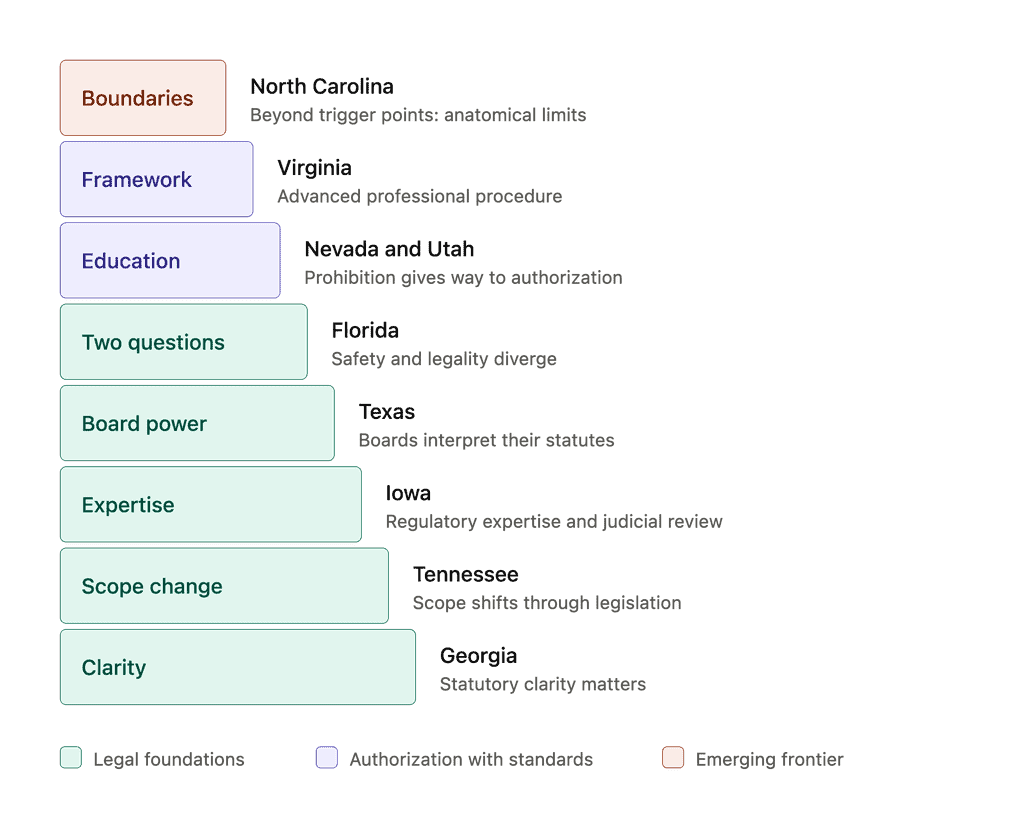
The most constructive regulatory approach is neither unrestricted professional expansion nor rigid protection of historically established techniques. Instead, it is a framework in which statutory authority, scientific evidence, professional competence, and patient safety guide clinical practice.
The central question should no longer be which profession first used a particular needle. It should be which appropriately trained healthcare professionals can use a particular intervention safely, effectively, ethically, and within their legally authorized scope of practice. Of course, this principle extends far beyond dry needling. It applies to the future of physical therapy, occupational therapy, chiropractic, acupuncture, and virtually every healthcare profession navigating the increasingly complex boundaries of modern clinical practice. Ultimately, patients benefit when regulatory decisions prioritize competence and public protection over professional territoriality, which should guide healthcare regulation.