
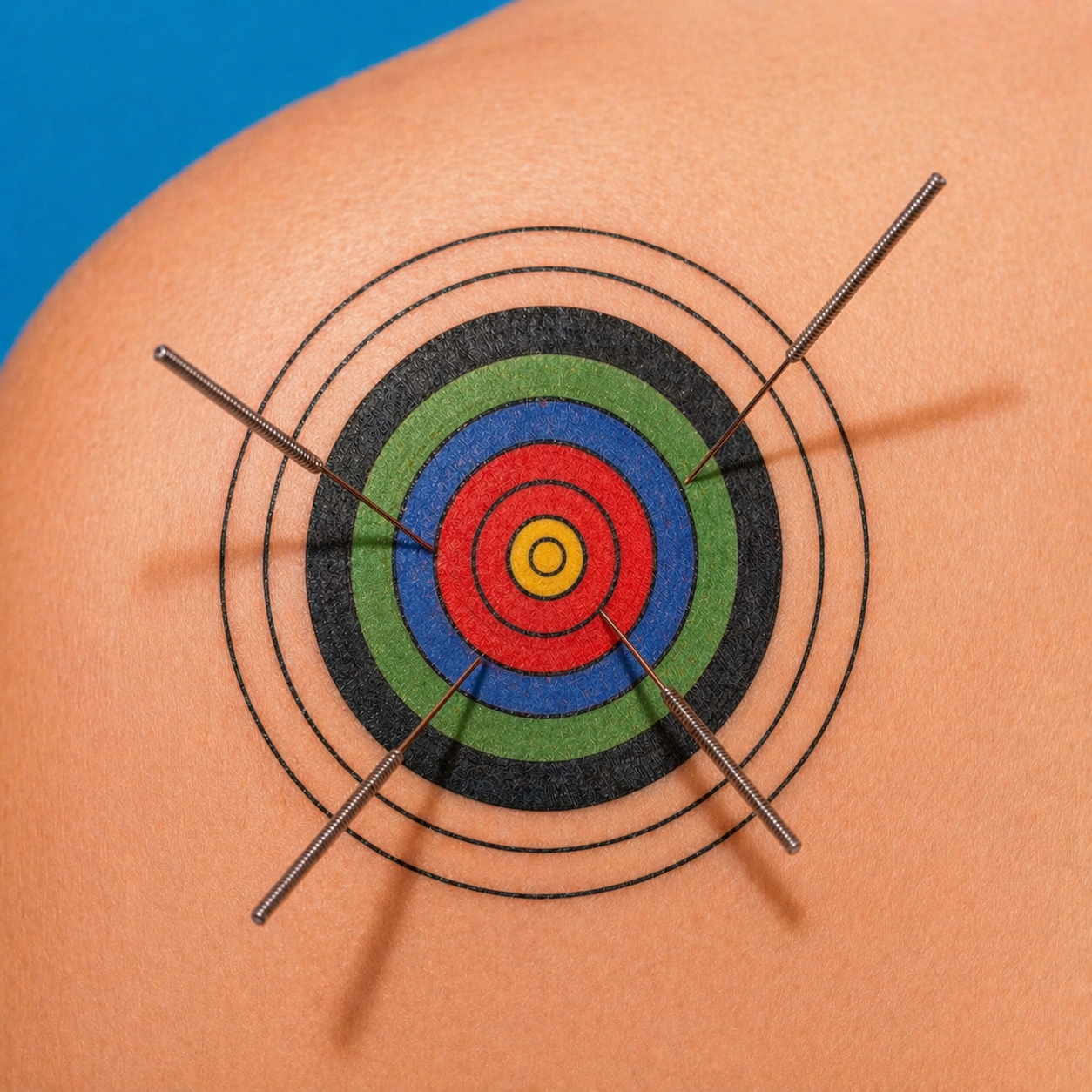
On April 20, 2026, the New York Times published a thought-provoking article about dry needling, judging by the many comments of readers of the newspaper.
I was honored to be cited in the article: “Many patients report an immediate sense of relief after a session, as well as an increase in muscle strength and range of movement,” said Jan Dommerholt, a physical therapist in Maryland who runs a certification program.”
The reporter, Andrea Javor, confirmed that dry needling has “become a standard part of orthopedic care, with superstar athletes like Travis Kelce and Caitlin Clark using the treatment for recovery and maintenance.”
Indeed, nearly every professional sports team in the US employs physical therapists or athletic trainers who use dry needling to improve their players’ performance and treat injuries. For example, I have trained the physical therapists of the Women’s Tennis Association (WTA), the Association of Tennis Professionals (ATP), and the Detroit Lions, among others. Athletes are increasingly interested in using dry needling for recovery, and I have co-authored several articles on the topic, including the Effect of dry needling on quadriceps muscles fatigue in taekwondo players.
One of Bethesda Physiocare‘s patients was asked to comment, and she could not be happier:
“I saw the muscles on my arm dancing while it was being done,” said Caroline Miller, a 64-year-old competitive swimmer from Maryland, of her experience with standard dry needling. But, she added, “the next day all the pain went away.”
Many others also shared their positive experiences in the comment section:
- “I had dry needling for tail bone pain, with the needles in my lowest spine. I have not had pain there for more than a year after about 6 dry needling sessions, plus physical manipulation akin to massage. I do recommend it.”
- “Dry needling, along with more PT, fixed my years-long piriformis problem. I had done the same PT exercises a million times and it helped a bit but never really fixed it. Several sessions of dry needling (those went in DEEP) actually worked. They also did my IT band which was *spicy* for sure. but helped there too. And, it’s medication free, so a big win.”
- “Thinking I was living with sciatica, I was diagnosed with bursitis of the hip. My doctor recommended physical therapy. As part of their treatment they did dry needling. The instant relief was unbelievable. That combined with the PT resulted in me being pain free for the past eight years.”
- “Dry needling relieved my inability to completely open my arm for 20 years following an accident. Over a year later, the extension is still perfect and all the pain is still gone. I know the plural of anecdote is not data, but I do encourage those living with chronic pain to explore the procedure!”
The reporter mentioned that dry needling can increase blood flow and reduce pain: “The basic idea behind dry needling is to create a tiny injury in a painful part of the body in hopes of increasing blood flow and loosening tight muscles, tendons and other tissue.”
Looking at the many comments, the article provoked some strong responses, especially from several acupuncturists who mostly offered outdated and refuted arguments, such as
- “Dry needling encroaches on the specialized field of acupuncture and risks devaluing the profession by allowing physical therapists to perform similar techniques with only a few hundred hours of training—far less rigorous than the extensive education required for acupuncture practitioners.”
The argument of insufficient training has been brought up in every jurisdiction where I have testified on behalf of the national APTA or state chapters. It does not take into account that physical therapists have completed doctoral-level education with significantly more education in anatomy, physiology, and pain sciences than any acupuncturist has received during their education. In every jurisdiction worldwide, physical therapists who use dry needling have legitimized acupuncture, and both professions have benefited. I found it interesting that Erik Vance, NY Times Editor for Health and Wellness, replied to many of the comments and actually referred the readers to one of our blogs!
- Others claimed that “what PTs are doing is dangerous. They do not have enough training to do the work they are doing. It makes all of us look bad.” Yet several studies on adverse events from dry needling do not support the claim that dry needling by PTs is dangerous.
Let’s do a little math and assume there are 40,000 PTs in the US trained in dry needling. Next, let’s assume that each PT performs dry needling with 5 patients per day, which amounts to 200,000 PT dry needling treatments per day. Let’s assume clinicians see patients five days per week, which brings the total number of dry needling treatments in the US to 1 million per week. Let’s next assume that those PTs work only 40 weeks per year. In other words, in this conservative estimate, dry needling is used 40 million times per year. If dry needling by PTs were “dangerous,” it would be fair to assume that physical therapy liability insurance companies would have to process many dry needling claims per year. Quite to the contrary, the APTA-endorsed professional liability insurance company, HPSO, is not concerned about PTs and malpractice claims at this time.
Another acupuncturist asked, “Have you ever heard of someone suffering a collapsed lung from acupuncture?” The truth is that adverse events, including pneumothoraces, do occur with acupuncture and dry needling, regardless of the clinician’s profession. I have been an expert witness in several legal cases in which a physical therapist was sued for causing a pneumothorax. To the best of our knowledge, serious adverse events, such as a pneumothorax, are rare within acupuncture and physical therapy, although the exact prevalence is unknown.
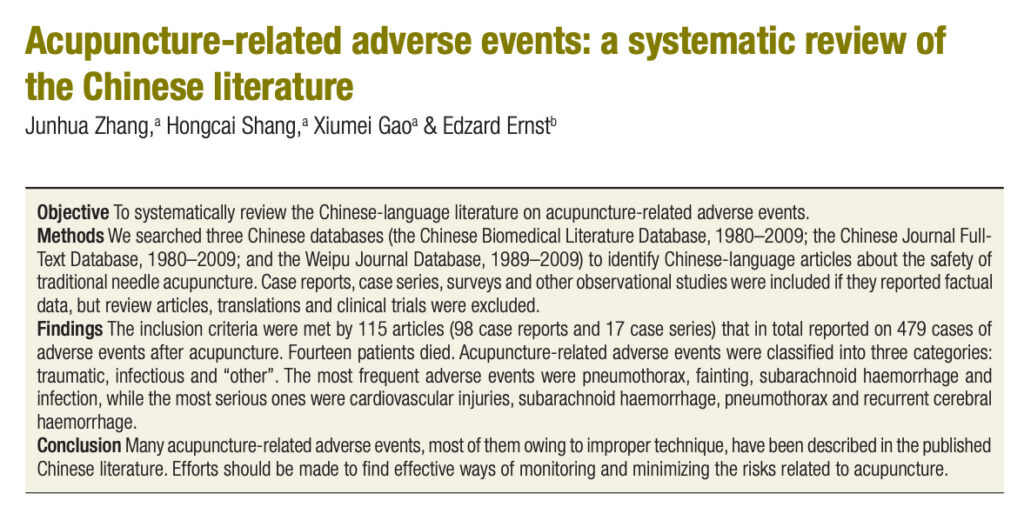
A systematic review of acupuncture-related adverse events reported that in a total of 479 cases of adverse events after acupuncture, 14 patients died (1). The most frequent adverse events were pneumothorax, fainting, subarachnoid hemorrhage, and infection, while the most serious ones were cardiovascular injuries, subarachnoid hemorrhage, pneumothorax, and recurrent cerebral hemorrhage.
A more recent systematic review also concluded that the most common serious adverse events related to acupuncture were pneumothorax, strong cardiovascular or vasovagal reactions, and falls or trauma with a frequency of one to three cases in one million treatments each (2).
The well-being of our patients is the most important and dry needling and acupuncture are valuable approaches.
“After a high ankle sprain I went to physical therapy and did everything the therapist told me me to. After 4 sessions there was little relief so she suggested dry needling. After 2 sessions, my ankle felt almost 100%. For me it was a godsend.”
Of course, many patients have equally wonderful experiences with acupuncture. Notably, the scope of practice for acupuncture is much broader than that of physical therapy. Patients may consult with acupuncturists for fertility issues, gastrointestinal problems, depression, and many other conditions, which are clearly outside the scope of physical therapy. The two disciplines overlap, but only in a small part of each profession’s scope of practice.
I would like to acknowledge Myopain Seminars graduate Ashley Katzenback from Cape Cod, Mass., who was also quoted in the article. She recommended asking clinicians “what type of certification they have, where they did their training and how long they’ve been practicing.”
As I mentioned in another blog, “The recognition of overlap across disciplines—from psychology and clinical social work to physical therapy and acupuncture—underscores a central truth that healthcare works best when professionals collaborate, not compete.
What matters most is not who owns a technique, but who can deliver it safely and effectively, in the best interest of the patient.
Lastly, it was a pleasure working with Andrea Javor again to explore dry needling, following our collaboration on her 2025 Newsweek article.
Jan Dommerholt, PT, DPT – President/CEO. Myopain Seminars
References
- Zhang J, Shang H, Gao X, Ernst E. Acupuncture-related adverse events: a systematic review of the Chinese literature. Bull World Health Organ. 2010 Dec 1;88(12):915-921C. doi: 10.2471/BLT.10.076737
- Bäumler P, Zhang W, Stübinger T, Irnich D. Acupuncture-related adverse events: systematic review and meta-analyses of prospective clinical studies. BMJ Open. 2021 Sep 6;11(9):e045961. doi: 10.1136/bmjopen-2020-045961.