
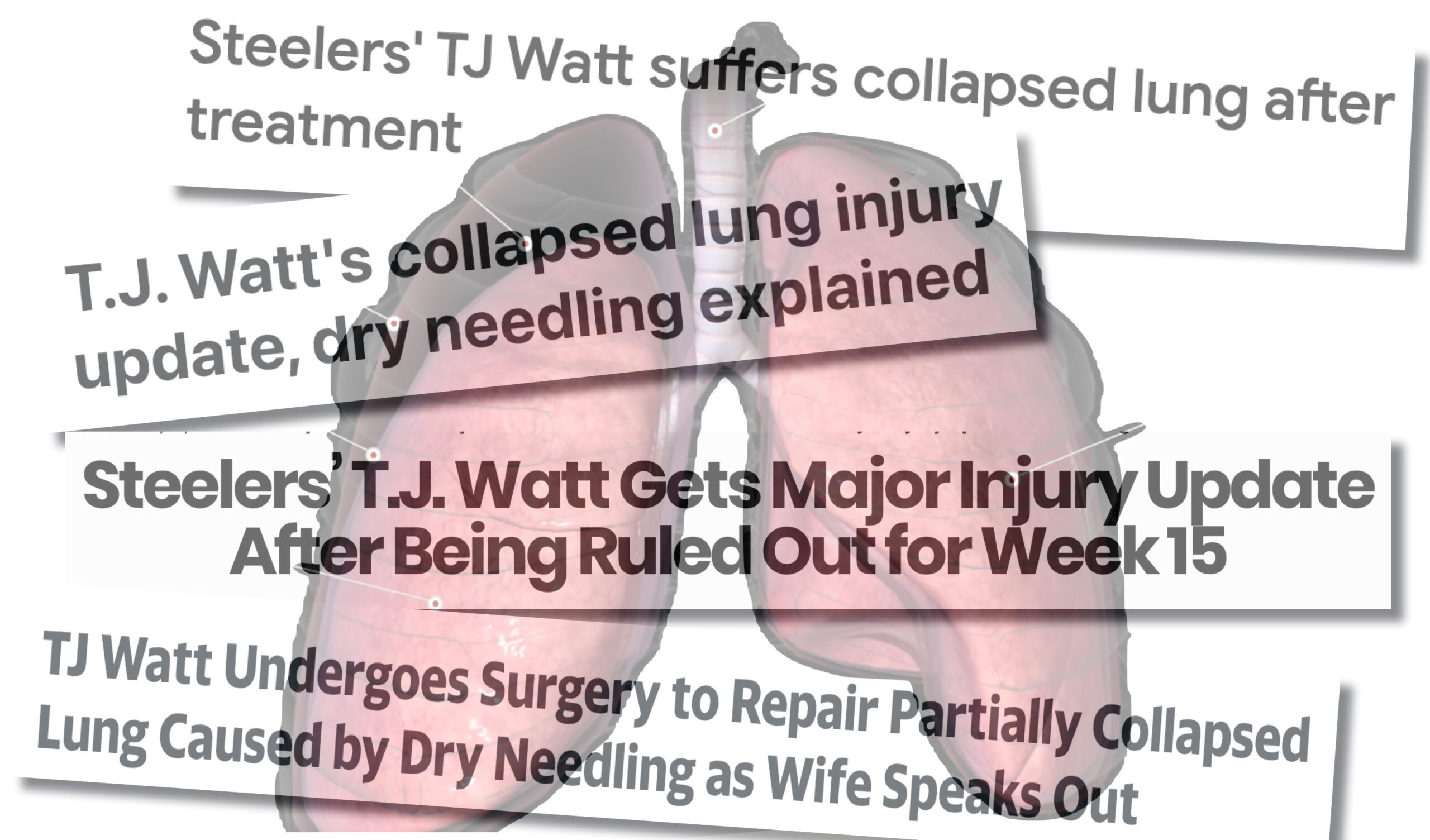
This past week, ESPN and pretty much every other major news outlet reported that the Steelers’ linebacker T.J. Watt underwent surgery to repair a partial pneumothorax after he was treated with dry needling at the team’s facilities. The Steelers have not provided much information about the incident, and it is unclear who caused the injury and under which circumstances.
What is clear is that dry needling made headlines this week. ESPN reporters Brooke Pryor and Stephania Bell wrote an article, “T.J. Watt’s collapsed lung injury update, dry needling explained,” in which our colleague Sue Falsone was quoted as saying, “pneumothorax [punctured lung] is reported in the literature as a very rare event.” Many other news agencies had similar articles and news stories, such as WCVB-5 (ABC, Boston), which ran a headline, “After T.J. Watt’s lung collapse, many are asking about dry needling. Here’s what to know.“
Other players were also eager to express their opinions. Steelers inside linebacker Patrick Queen said, “… I don’t do the whole dry needle thing. I’m actually scared of dry needling, so I kind of stay away from that stuff.” Queen prefers acupuncture, as “there’s a whole much more scientific thing that goes into it.” Whether acupuncture has a stronger scientific basis than dry needling is debatable, but everyone is entitled to having strong opinions.
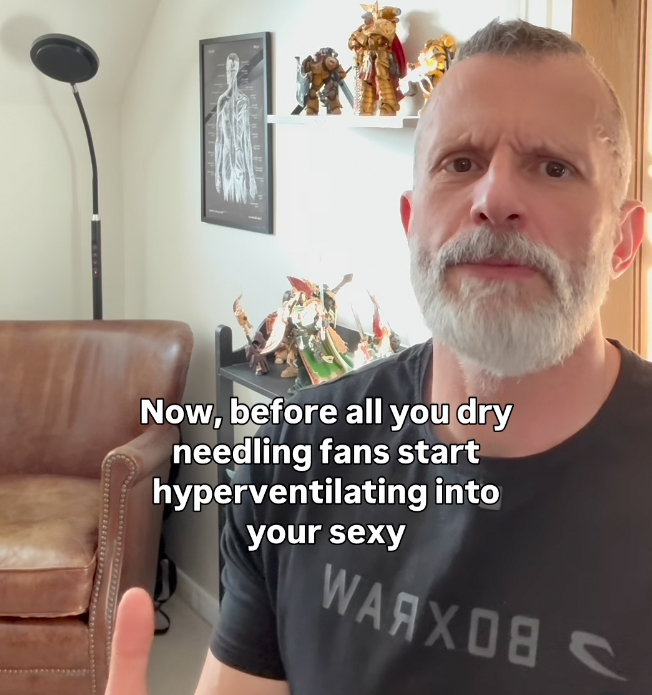
Adam Meakins, never shy to critique dry needling, said, “Now, before all of you dry needling fans start hyperventilating into your sexy black latex gloves…… I know pneumothorax is a very rare risk but it’s also a well-known risk. Inserting needles in the chest and upper back can in the wrong hands and at the wrong angle cause a pneumothorax…..
“And here’s the part that nobody wants to say out loud, dry needling isn’t some superior magical treatment that’s actually worth taking this risk for.”
“Why people still use dry needling over other simpler, cheaper, and much safer treatments in this day and age is beyond me. The risk/reward ratio here is just not good. Don’t get needling.”
Meakins is correct in confirming that the risk of a serious adverse event, such as a pneumothorax, is minimal. In our adverse event study (1), we concluded that the risk was less than 0.04% based on almost 8,000 physiotherapy treatments. Meakins cited two other professional athletes, Olympic freeskier Torin Yater-Wallace and Canadian Olympic judoka Kim Ribble-Orr, who suffered pneumothoraces in 2013 and 2015, respectively. Given that every professional sports team in the US offers dry needling as one of its available treatment modalities, three known pneumothoraces in 12 years involving high-level athletes in two countries constitute a tiny percentage of the dry needling treatments likely administered during that time frame. Even if the actual number of pneumothoraces exceeded three, it would still be a very small percentage. I wonder what percentage Meakins would consider acceptable from a risk management perspective.
As a side note, I actually do agree that dry needling is not some magical treatment. I start most of my lectures and workshops about dry needling stating that “no one needs dry needling,” followed by “but…. few therapy approaches are as effective as dry needling,” which is where Mr. Meakins and I likely part ways.
Recognizing that, in another context, sexy, latex, and gloves may go together, very few clinicians use latex gloves with dry needling, because, from a risk management perspective, nitrile gloves are much safer. Latex gloves exhibited more toxicity in cell culture than non-latex gloves (2), and their repeated use often leads to allergic contact dermatitis. Don’t get latex.

Meakins seems to think that dry needling is used primarily for recovery; however, that is only one possible application (3-6), and frankly, not much is known about its utility (7). The main effect of dry needling is its analgesic effect (8), and generally, athletes have a positive impression of dry needling (9-12).
Looking at the professional athletes we have treated in our physical therapy clinic, Bethesda Physiocare, many of these players seek dry needling outside the team’s facilities because they are dissatisfied with and concerned about the quality and safety of dry needling supported by their teams.
With close to 60 dry needling course providers in the US, the quality of dry needling education does vary considerably. There are dry needling course providers with questionable levels of training and experience, yet state boards of physical therapy tend to approve nearly all applicants. As we mentioned in a previous blog, course providers may be less than honest in their applications to become approved providers. One particular course provider claimed that their graduate physical therapy school training included a complete course in dry needling. Upon verification, the professor who taught the class that introduced dry needling to this course provider confirmed that the PT students only needled the quadriceps. The same course provider stated that, following graduation from PT school, they moved to Oregon, where they performed dry needling for several years, even though dry needling was not within the scope of their practice in Oregon.
Nevertheless, the course provider has been approved in several states throughout the country as a qualified instructor of dry needling courses. It is conceivable that such unqualified dry needling instructors could also wiggle their way into professional sports teams and offer inferior dry needling. How would the team’s medical director and management know the difference between excellence and mediocracy?
How many of those course providers are still teaching to use an intercostal blocking approach when needling the rhomboid muscles? In a recent paper published in Physical Therapy, we recommended against using a rib-bracketing technique in the intrascapular region, where palpating the ribs is unreliable (13). Dry needling in “the wrong hands” is indeed worrisome. It seems that professional teams can afford to hire high-quality staff and invest in training to ensure the safety and well-being of their athletes, as several companies have done. I have personally trained physical therapists from the ATP, the WTA, the Detroit Lions, the Detroit Red Wings, and the Qatari sports medicine center, Aspetar, among others. I am not suggesting that the healthcare providers at the Steelers would not be qualified. Still, empirically, many athletes nationwide do not appear to be very impressed with the quality of in-house medical care.
We may never learn what happened during TJ Watt’s dry needling treatment. Which muscles were needled? What was the needle length and needle angle? What approach did they use? What was the background and discipline of the responsible healthcare provider, and where were they trained in dry needling? Was the needle left in place or did the healthcare provider use a pistoning technique, which was found to be more effective in a recent study (14). According to the researchers, “classical dynamic (pistoning) dry needling induced greater short-term improvements in mechanical and perfusion outcomes of the upper trapezius than static or sham procedures, suggesting that needle manipulation intensity modulates physiological responses” (14).
Since TJ Watt had no complications, he returned to playing football a few weeks later. Fans would like to see him return to play much sooner, but they should consider that when Torin Yater-Wallace returned to competition less than two weeks after being released from the hospital, he re-collapsed his lung!
“I think a lot of guys, not only in this facility, but across professional sports use dry needling a lot,” Watt said. “It just happened to be a fluke thing” (NY Times, January 2, 2026).
Jan Dommerholt, PT, DPT | President/CEO, Myopain Seminars
References
- Brady, S., McEvoy, J., Dommerholt, J., & Doody, C. (2014). Adverse events following trigger point dry needling: a prospective survey of chartered physiotherapists. The Journal of Manual & Manipulative Therapy, 22(3):134–140. https://doi.org/10.1179/2042618613Y.0000000044.
- Cormio L, Turjanmaa K, Talja M, Andersson LC, Ruutu M. Toxicity and immediate allergenicity of latex gloves. Clin Exp Allergy. 1993 Jul;23(7):618-23. doi: 10.1111/j.1365-2222.1993.tb00903.x. PMID: 8221263.
- Loudon, J., & Ball, Y. (2024). Does dry needling aid in post-training recovery? A critically appraised topic. Journal of Bodywork and Movement Therapies, 40:1093–1096. https://doi.org/10.1016/j.jbmt.2024.07.017
- McCray, S. and J.M. Boyd, Perceptions of dry needling for performance & recovery in NCAA Division I athletes. Sports J, 2019.
- Brewster, B. D., Snyder Valier, A. R., & Falsone, S. (2022). A Systematic Dry-Needling Treatment to Support Recovery Posttraining for Division I Ice Hockey Athletes: An Exploration Case Series. Journal of Athletic Training, 57(8), 788–794. https://doi.org/10.4085/1062-6050-0096.21
- Tang, C.T. and B. Song, Acupuncture and Dry Needling for Sports Performance and Recovery. Curr Sports Med Rep, 2022. 21(6):213–218.
- Ershad, N., Ansari, N., Naghdi, S., Otadi, K., Gorji, E., & Dommerholt, J. (2019). The Effects of Dry Needling As a Novel Recovery Strategy on Quadriceps Muscle Fatigue: A Pilot Study. Journal of Iranian Medical Council, 2(6): 215-221
- Murillo, C., Cerezo-Téllez, E., Torres-Lacomba, M., Pham, T. Q., Lluch, E., Falla, D., & Vo, T. T. (2024). Unraveling the Mechanisms Behind the Short-Term Effects of Dry Needling: New Insights From a Mediation Analysis With Repeatedly Measured Mediators and Outcomes. Archives of Physical Medicine and Rehabilitation, 105(12):2269–2276. https://doi.org/10.1016/j.apmr.2024.07.016
- Thompson, R., Prosell, M., & Timpka, T. (2021). Elite athletes’ experiences of musculoskeletal pain management using neuroanatomical dry needling: A qualitative study in Swedish track and field. Journal of Science and Medicine in Sport, 24(1):46–51. https://doi.org/10.1016/j.jsams.2020.07.004
- Demeco, A., de Sire, A., Salerno, A., Marotta, N., Palermi, S., Frizziero, A., & Costantino, C. (2024). Dry Needling in Overhead Athletes with Myofascial Shoulder Pain: A Systematic Review. Sports (Basel, Switzerland), 12(6):156. https://doi.org/10.3390/sports12060156
- Kamali, F., Sinaei, E., & Morovati, M. (2019). Comparison of Upper Trapezius and Infraspinatus Myofascial Trigger Point Therapy by Dry Needling in Overhead Athletes With Unilateral Shoulder Impingement Syndrome. Journal of Sport Rehabilitation, 28(3):243–249. https://doi.org/10.1123/jsr.2017-0207
- Pavlović, B., Toskić, L., Cicović, V., Cicović, B., & Stanković, V. (2024). The Effects of Dry-Needling Therapy on the Quality of Life in Athletes with Myofascial Pain Syndrome: Repeated Measures Design Study. Journal of Clinical Medicine, 13(17):4969. https://doi.org/10.3390/jcm13174969
- Mintken, P. E., Denman, B., & Dommerholt, J. (2025). Pneumothorax After Dry Needling of Intrascapular Muscles Using a Rib Bracketing Technique: Insights From the Clinician, Patient, and Clinical Expert. Physical Therapy, 105(8):pzaf078. https://doi.org/10.1093/ptj/pzaf078
- Olaniszyn, G., Kużdżał, A., Taradaj, J., & Trybulski, R. (2025). Comparative effects of static, classical, and sham dry needling on muscle properties and autonomic nervous system activity in cervical myofascial pain syndrome. Complementary Therapies in Medicine, 96, 103314. Advance online publication. https://doi.org/10.1016/j.ctim.2025.103314