
Introduction
One of the reasons for our monthly legislative reviews is to track and make sense of the many laws, rules, and regulations across the United States and other countries. Foreign analysts are often amazed that each US state and jurisdiction has its own rules, assuming they even have rules.
Crocker and Parent (2026) investigated the regulation of dry needling by physical therapists across the United States (US) regulatory jurisdictions:
Of 56 physiotherapy jurisdictions in the United States (50 states, 1 district and 5 territories),

     * 43 jurisdictions permit physical therapists to practice DN.
     * Of these,
            * 22 legislate it
            * 2 regulate it using DN policy
            * 5 have both legislation and policy, and
            * 14 have neither

Additionally, 5 prohibit the practice and 8 are silent on the topic.

Comparisons of jurisdictional DN regulations to documents presenting regulation recommendations highlight gaps in regulation across jurisdictions.

Jurisdictions have multiple and inconsistent requirements, including
      * 24 jurisdictions having a course approval process
      * 22 requiring specific course content for DN courses
      * 21 requiring a minimum duration of DN instruction
      * 11 requiring clinical experience prior to practicing DN
      * 7 having an attestation form for DN
      * 4 reporting a registration or rostering system of physical therapists practicing DN, and
      * 1 mandating continued competency education for DN
The authors suggested that national regulatory guidelines may help reduce heterogeneity across jurisdictions by ensuring a minimal standard of competency, specifically from a safety perspective.
You may recall that before the COVID pandemic, the Federation of State Boards of Physical Therapy (FSBPT) implemented ProCert, advertised as a valuable program, providing
• an activity with multi-state approval for meeting licensure renewal requirements for PTs and PTAs; and
• activities meeting both the required standard and also value-added standards and higher credit awards.
We applauded the FSBPT’s initiative, and Myopain Seminars was awarded ProCert approval. The manual required to complete the application was about 50 pages long and so complicated that we hired a consultant.
About three months after having been approved, the FSBPT canceled its ProCert program. Crocker and Parenty did not include this effort in their paper, but, in principle, ProCert had the potential to serve as a national regulatory system.
Back to Crocker and Parents’ analysis: comparing the US and Canada, 71% and 100% of jurisdictions, respectively, allow physical therapists to practice DN. The actual number is higher in the US, as several states allow PTs to use dry needling without having published regulations. At this point, only Hawaii, California, and New York specifically do not permit dry needling by PTs.
In the US, 54% of cases are regulated by legislation, 5% by policy, 12% by both, and 34% are not regulated.
In Canada, 15% are regulated by legislation, 8% by policy, 54% by both, and 15% are not regulated.
Prerequisites are required in 27% of US jurisdictions and 23% of Canadian jurisdictions.
Course approvals are noted in 59% of US jurisdictions and in 23% of Canadian jurisdictions.
Reference: Crocker, Nadine, and Eric Parent. 2026. “Environmental Scan of the United States Regulatory Practices of Physical Therapy Dry Needling,” Physiotherapy Research International: e70225. https://doi.org/10.1002/pri.70225.
Brazil
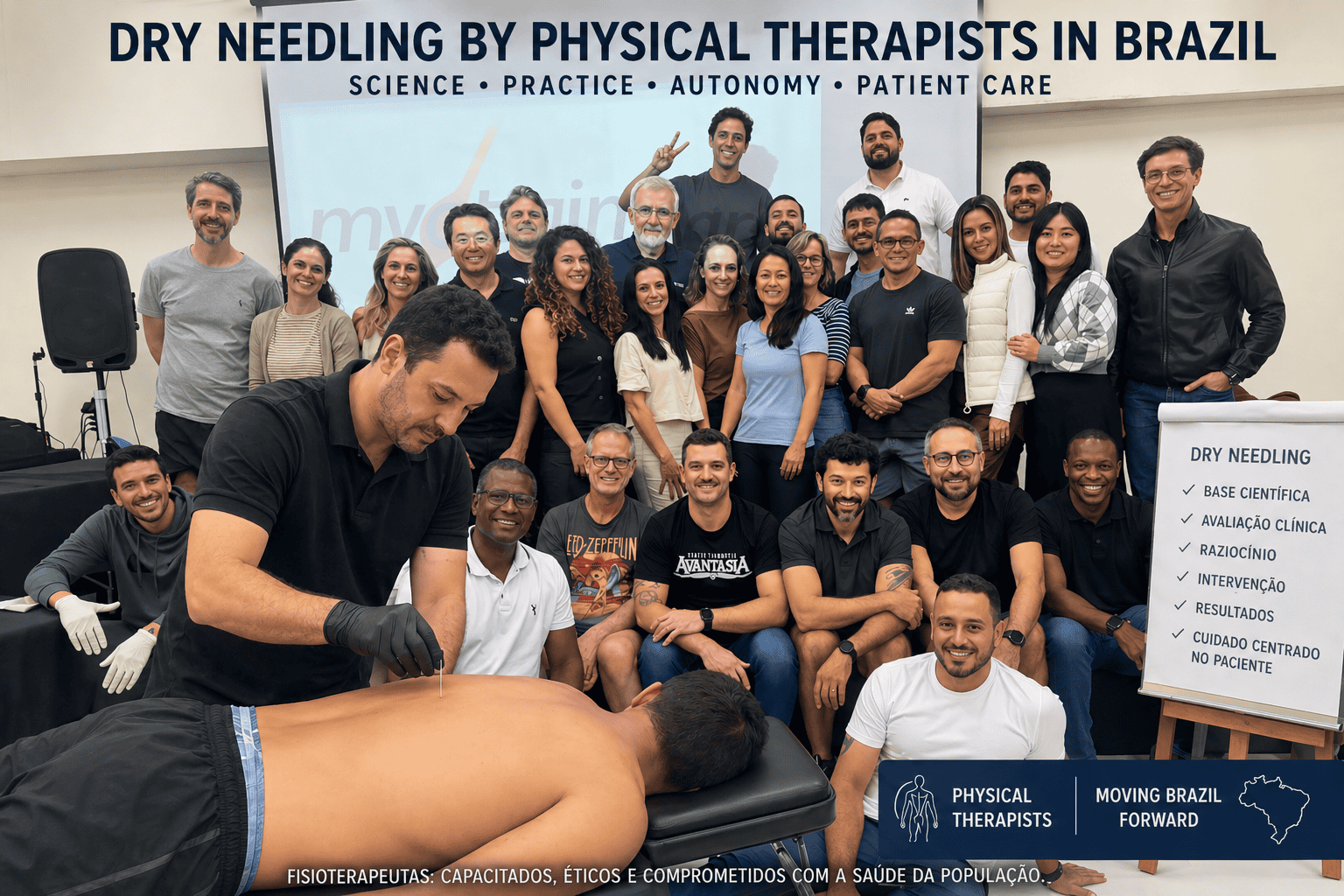
On September 12, 2016, Brazil’s Federal Council of Physical Therapy and Occupational Therapy (COFFITO) unanimously declared that dry needling falls within the scope of physical therapy practice, as per Resolution No. 481/2016.

It did not take long for the Brazilian Medical College of Acupuncture (CMA) to file a lawsuit against the Council with the Federal Regional Court of the 1st Region (TRF1).
On October 16, 2019, the Courts reached a verdict and annulled Resolution No. 481/2016 and the resolutions derived from it. According to the Court’s Ruling, “dry needling is a practice derived from acupuncture, consisting of the insertion of a physical material to treat inflammation and other conditions. It has been described as a defective term often used to refer to acupuncture based on musculoskeletal anatomy and myofascial physiology—more appropriately termed “myofascial trigger point acupuncture.”
As a side note, in a recent webinar for members of the International Acupuncture and Dry Needling Association of Physiotherapists (IADAPT), I noted that, from a physical therapy perspective, dry needling originated in the medical practice of trigger point injections. However, from an acupuncture perspective, dry needling is no different from needling Ashi points, which was already recommended in the Ling Shu, translated as “Spiritual Pivot.” This cardinal acupuncture source is part of the Huangdi Neijing, or Yellow Emperor’s Inner Canon, likely compiled between the 2nd and 1st centuries BCE during the Han Dynasty. Ashi needling remains an established practice in acupuncture.
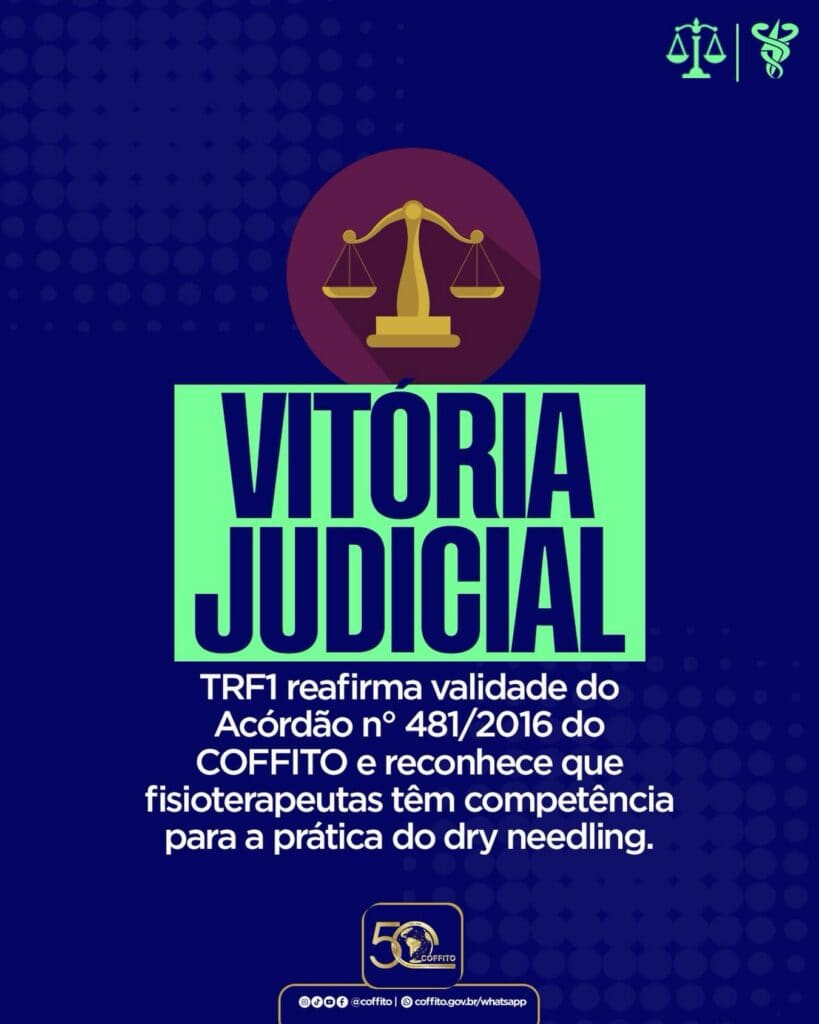
Back to Brazil. The COFFITO appealed the Court’s ruling to the 7th Panel of Judges of Brazil’s Federal Regional Court of the 1st Region, a federal appeals court. The Appeals Court unanimously upheld COFFITO’s appeal and recognized the validity of COFFITO Resolution No. 481/2016.
On April 28, 2026, the Court acknowledged similarities between dry needling and acupuncture. It also recognized the consolidation of a new legal framework through Law No. 15,345/2026, which regulates acupuncture as a plural and multiprofessional field, allowing its practice by healthcare professionals with higher education and specific qualifications. The law was published on January 12, 2026, by the President of the Federative Republic of Brazil, Luiz Inácio Lula da Silva.
In other words, the lower court’s assumption of a medical monopoly was dismissed, and the ruling was overturned.
According to the Appeals Court, “the new legislation established an explicit legal basis addressing the central issue of the case, reinforcing that COFFITO’s progressive stance is aligned with current federal law and with the protection of society through the requirement of technical qualification of professionals.”
As a result, COFFITO’s institutional authority to regulate and supervise the professional practice of Physiotherapy is reaffirmed, including the use of dry needling by properly trained professionals. This represents an important precedent in defense of professional autonomy, legal certainty, the appreciation of Physiotherapy, and the recognition of healthcare as a multiprofessional field.
Source: Case No. 1014957-42.2019.4.01.3400, Judgment Session held on April 28, 2026.
California
On May 6, AB 2497 (Modernization of the California PT Practice Act) was placed on the California Assembly Suspense Calendar. The suspense calendar is a procedural tool used by the California Legislature to manage bills with significant fiscal impact (legislation proposed to cost the state $150,000 or more). It allows the Appropriations Committee to decide the fate of these bills in a single hearing.
Bills are either advanced for a vote or held and effectively “Fail” without a public explanation. On May 14, 2026, the Assembly Appropriations Committee passed the Bill with certain amendments………

On May 21, 2026, Oscar Gallardo, PT, DPT, President of the California Physical Therapy Association, informed its members that dry needling had been removed from the bill!
| CPTA did not support removing dry needling from the bill, nor were we or the bill author informed in advance that the language would be stripped in the Assembly Appropriations Committee. The amendment occurred during the committee process, which is often conducted without stakeholder input or prior notice to bill sponsors and advocates. |
Dr. Gallardo placed part of the blame on the lack of involvement by California physical therapists. According to Dr. Gallardo, “opposition groups, particularly the acupuncture community, organized a highly visible and aggressive advocacy campaign against the provision. They attended hearings in force, met directly with legislators and staff, and maintained sustained pressure throughout the process.
By contrast, physical therapists did not engage at the same scale or intensity. Legislators notice who shows up, who organizes, and who consistently advocates. In Sacramento, advocacy matters.”
Even though dry needling will not be within the scope of physical therapy in California in the foreseeable future, Bill AB 2497 contains other important language that will bring significant changes to PT in the state.
The bill will be heard next on the Assembly Floor in late May.
Florida
On May 22, 2026, Florida Governor Ron DeSantis approved HB 867, which allows occupational therapists to begin using dry needling on July 1, 2026. The minimum requirements include

Two years of licensed practice as an OT
Completion of an approved 50-hour face-to-face continuing education course on dry needling that includes
instruction on dry needling theory
selection and safe handling of needles and other apparatus or equipment used in dry needling, including the proper handling of biohazardous waste
indications and contraindications for dry needling
psychomotor skills needed to perform dry needling, and
an assessment of whether the OT has the requisite psychomotor skills to safely perform dry needling
post-intervention care, including adverse responses, adverse event recordkeeping, and any reporting obligations
Completion of 25 patient sessions of dry needling performed
Under the supervision of any OT who holds an active license to practice physical therapy in any state or the District of Columbia, and who has actively practiced dry needling for at least one year; or
As an OT licensed in another state or in the U.S. Armed Forces
Netherlands
The Dutch Physiotherapy Quality Council has updated its position statement on dry needling. After reassessment based on the current criteria, the position remains unchanged: dry needling falls within the scope of physiotherapy, but it must be part of an assessable physiotherapy treatment plan. The Physiotherapy Quality Council consulted with Jan Dommerholt, President and CEO of Myopain Seminars.

Within physiotherapy, dry needling is classified as a specialized procedure. Therefore, the advice and recommendations in the brochure Careful Practice in Reserved and Specialized Procedures, as well as the KNGF Recommendations for the Safe Application of Dry Needling, apply and should be consulted beforehand.
Notably, the recommendations were written by physiotherapists Beersma, Eleveld, Leidekker, van Liere, Luitjes, and Timmermans. Most of the authors are affiliated with Myofasciale Pijn Seminars, our partner organization in the Netherlands.
How are position statements established in the Netherlands?
Since 2023, the Quality Council has established position statements based on the Professional Profile of the Physiotherapist and additional criteria. These position statements determine which interventions do or do not belong within the professional scope. With each new or revised decision, the professional standard, Position Statements Regarding the Scope of Physiotherapy, is updated.
Pennsylvania
House Bill 2070, sponsored by Representative John Schlegel, would allow physical therapists in Pennsylvania to use dry needling and has been in the House Professional Licensure Committee since December 3, 2025.

According to the Bill, “Dry needling” shall mean a physical intervention that uses a filiform needle to stimulate trigger points and diagnose and treat neuromuscular pain and functional movement deficits. The term does not include the stimulation of auricular or any other points based upon areas of oriental medicine or the practice of acupuncture under the act of February 14, 1986 (P.L.2, No.2), known as the “Acupuncture Licensure Act.”