
Following board meetings in October and November 2025, the Maryland Board of Physical Therapy Examiners posted a notice on its website accepting written comments on amending Regulation .01—.05 under COMAR 10.38.12 Dry Needling. The deadline for submitting comments was December 5, 2025.
On December 4, 2025, Myopain Seminars issued a last-minute announcement inviting our subscribers to review the proposed amendments and, if they wish, post comments expressing their opinions.
The proposed amendments include many significant changes, such as:
- Physical therapists will be allowed to practice dry needling immediately after graduating from PT school, provided they have completed the necessary training. There will no longer be a two-year waiting period.
- The number of live theory hours will be reduced from 40 to 10.
- Physical therapy assistants will be allowed to practice dry needling after 2 years of practice. The proposed regulations state that they may practice dry needling only under the supervision of a physical therapist who is also registered to practice dry needling.
- Dry needling courses will no longer require pre-approval by the APTA of Maryland.
- The Board proposes that dry needling education completed during PT school will be accepted. Currently, only post-graduate dry needling education is accepted.
- Written informed consent for dry needling will no longer be required.
- After completing 10 hours of in-person theory education and 10 hours of hands-on instruction, physical therapists and physical therapy assistants may apply for a provisional registration to begin practicing dry needling within their competency. The remaining 60 hours of education must be completed within 2 years.
It is no secret that I am not in favor of Maryland’s current dry needling regulations, as I have expressed in several blog posts on our website. See for example
Update on the Maryland Dry Needling Regulations
State Board DN Regulations May Not Always Protect the Public
Important Information for Physical Therapists Licensed in Maryland
Myopain Seminars did not support the Maryland 2018 DN Regulations
In 2024, I shared my concerns with Dr. Silke Elsner, the Continuing Education & PT Compact Privileges Manager for the Maryland Board. At that time, she assured me she was working to implement changes. But she also warned me that any change must go through an extensive and time-consuming legal process.
I am pleased to see that the arbitrary two-year waiting period has been removed. Dry needling is anatomy-based, and requiring new graduates to forget their anatomy knowledge before using an invasive procedure never made any sense to me. I am also pleased that a written informed consent specifically for dry needling will no longer be required. There is no other treatment modality that requires a specific written consent form.
Under the proposed rules, physical therapists can start using dry needling provisionally after receiving training; however, I do not support the arbitrary number of hours attached to this privilege. How did the Board determine that 10 hours of in-person instruction is the magical number? I agree with in-person training, but why connect this to a minimum number of hours? States that do not have an arbitrary minimum number of hours do not appear to have increased numbers of serious adverse events. In Virginia, for example, the only requirement is competency, and I believe that competency should be the only criterion and not some arbitrary number of hours. It is customary to assume competency upon completion of an approved course and not after 10 hours of in-person instruction. Is there any other treatment modality where the Board requires a minimum number of hours? I recommend eliminating the requirement for a minimum number of in-person instruction hours.
“Competency should be the only criterion…..
Similarly, why are there still a minimum hours of training requirements, such as “at least 80 total hours of instruction,” “at least 40 hours of instruction,” and “at least 40 hours of [practical,] hands-on instruction.” Any number of hours set in regulations is entirely arbitrary and has no scientific basis. I do not believe that State regulations should include any speculative or arbitrary number of hours, primarily based on irrational and emotional arguments. Many states, such as North Carolina and Virginia, and even countries, such as Ireland, the Netherlands, and Switzerland, do not require a minimum number of hours. There is no evidence that physical therapists in those states and countries would be less safe when practicing dry needling. The primary mission of the Board is to protect the public, and including arbitrary numbers of hours runs counter to that purpose. I recommend eliminating the minimum number of hours requirement.
Interestingly, the Board proposes that physical therapy assistants may use dry needling after an arbitrary 2-year waiting period. This proposed policy contrasts with the positions of the national APTA and the Federation of State Boards of Physical Therapy (FSBPT). The APTA maintains that PTAs lack the necessary education to use dry needling, and in 2018, the APTA amended one of its APTA House policies to confirm that dry needling is an intervention that a physical therapist should not delegate to a physical therapist assistant. The FSBPT does not appear to support dry needling by PTAs either, according to the Analysis of Competencies for Dry Needling by Physical Therapists Final Report, published in 2015.
“Because this report focused on the competencies required of the PT to perform dry needling, which are based on a strong foundation in evaluation and differential diagnosis, it is not appropriate to assume the same competencies would qualify a PTA to perform the treatment.
Analysis of Competencies for Dry Needling by Physical Therapists Final Report
As I summarized in the blog “Dry Needling by Physical Therapy Assistants,” PTAs are allowed to use dry needling in a few other states. Is there any data supporting the use of dry needling by PTAs? How many PTAs are currently using DN in other states? Is the risk profile similar to PTs? How did the Maryland Board determine that two years of waiting would make a PTA safe using DN? Is this another arbitrarily chosen time period?
Furthermore, why is there still a minimum requirement for live hours of theoretical education? Granted, it is reduced from 40 to 10 hours, but I am not aware of any logical, evidence-based minimum number of hours required for live theoretical education. My recommendation is to remove the live education requirement.
Regarding 2B of the proposed amendments, the Board will accept dry needling courses offered during a physical therapy student’s graduate education, which is a significant change from the current rules. I am aware of only one scientific study supporting pre-graduation dry needling training. According to Barrett and colleagues (2025), dry needling can be safely included within DPT education, with risks similar to those in clinical practice. A close review of the survey, however, revealed that higher-risk muscles over the lung field were not included in the students’ dry needling experience. The lower-extremity muscles were overrepresented, which may explain why the risk profile was relatively favorable. More challenging muscles, such as the serratus anterior, the rhomboid muscles, and the thoracic multifidi, were not included (Table 1).
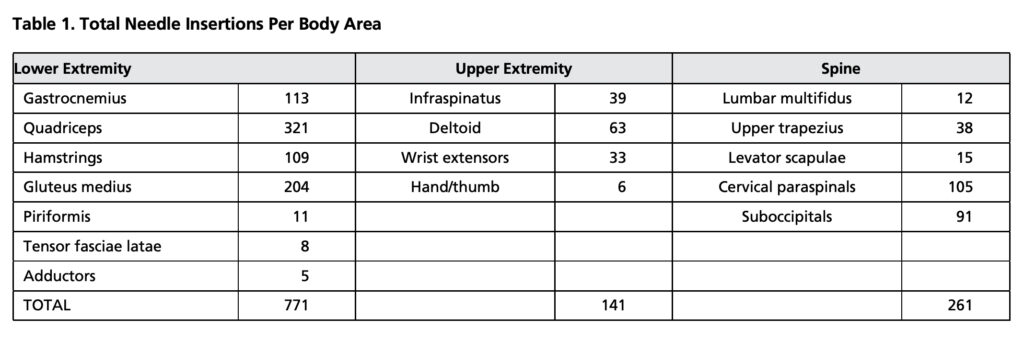
A recent case report by Mintken, Denman, and Dommerholt (2025) discussed a dry needling pneumothorax case after an experienced physical therapist attempted to needle the rhomboid muscles.
I am not convinced that students have sufficient clinical reasoning skills to determine when dry needling would be indicated and, perhaps more importantly, when it may not be the preferred treatment.
As always, we will keep you updated about all legal issues related to dry needling. When the Maryland Board shares any further information, Myopain Seminars will be the first to share it with you!
Jan Dommerholt, PT, DPT, President/CEO, Myopain Seminars
References
1. Barrett, T.L., et al., Dry Needling in United States Doctor of Physical Therapy Programs: Safety Assessment and Adverse Event Reporting. J Phys Ther Educ, 2025. 39(4), 348–354. https://doi.org/10.1097/JTE.0000000000000393
2. Mintken, P.E., B. Denman, and J. Dommerholt, Pneumothorax After Dry Needling of Intrascapular Muscles Using a Rib Bracketing Technique: Insights From the Clinician, Patient, and Clinical Expert. Phys Ther, 2025. 105(8) pzaf078, https://doi.org/10.1093/ptj/pzaf078