
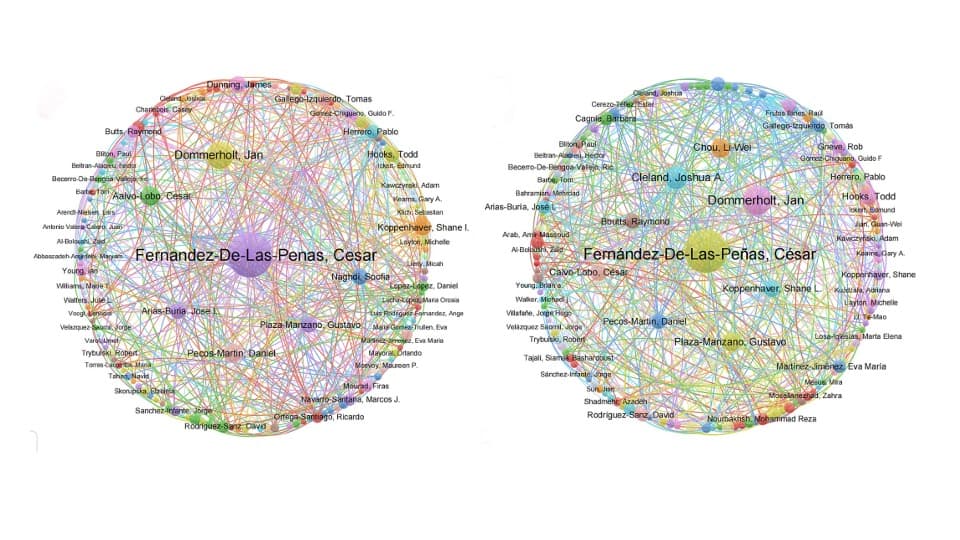
A new bibliometric analysis published in Frontiers in Neurology confirms what many clinicians, educators, and researchers in the dry needling community have recognized for years: Jan Dommerholt is one of the most influential contributors to the scientific literature on dry needling and pain.
The article, “A dual-database bibliometric analysis on dry needling for pain: Global trends and hotspots from Web of Science Core Collection and Scopus (2006–2025),” analyzed nearly two decades of publications on dry needling and pain. Using both Web of Science Core Collection and Scopus, the authors mapped publication trends, authorship networks, institutional productivity, citation patterns, and emerging research themes.
One of the most notable findings is that Jan Dommerholt ranked as the second-most-productive author in the world in both databases. In Web of Science, Dommerholt was listed with 33 articles, and in Scopus with 32 articles. This places him immediately behind César Fernández-de-las-Peñas and ahead of other well-known contributors, including Joshua Cleland and César Calvo-Lobo. Of course, Dommerholt and Fernández-de-las-Peñas have published several textbooks and articles together. The third edition of their long-awaited “Dry Needling; An Evidenced and Clinical-Based Approach” will be published later this year!
The analysis also showed that Dommerholt’s work is not only prolific but also influential. In Scopus, his publications accumulated 496 citations, with an H-index of 15 and a G-index of 21 in this specific research domain. These indicators reflect a sustained and meaningful scholarly impact in dry needling and pain science.
The institutional analysis further highlights the role of Myopain Seminars. In the Web of Science dataset, Myopain Seminars ranked fifth among the most relevant affiliations, with 28 articles and a strong collaboration profile. This is particularly significant because most of the highly ranked institutions were universities or major academic centers. The presence of Myopain Seminars among these institutions demonstrates the organization’s unique role in bridging clinical education, international collaboration, and research dissemination.
The article also confirms the broader growth of dry needling research. From 2006 to 2025, publications increased steadily, reflecting expanding global interest in dry needling as a pain management intervention. The United States and Spain emerged as the leading countries in publication output and international collaboration, with dry needling research increasingly focused on clinical effectiveness, mechanisms of myofascial trigger points, trial methodology, outcome measures, and safety.
For clinicians, this bibliometric analysis matters because it shows that dry needling is no longer a niche intervention supported only by isolated studies. It has become an established and expanding area of pain and rehabilitation research. Within that field, Jan Dommerholt’s ranking demonstrates a long-standing contribution to the development, education, and scientific foundation of dry needling.
In short, this study once again places Jan Dommerholt among the central figures in the global dry needling literature. This study confirms the findings of two other bibliometric studies, reviewed in a previous blog. His ranking as the second-most-productive author across both major scientific databases, together with the strong placement of Myopain Seminars among leading affiliations, underscores an enduring contribution to the advancement of dry needling, myofascial pain, and evidence-informed clinical practice.
A Few References
Liao M, Cheng X, Liu F, Xiong X and Yu Y (2026) A dual-database bibliometric analysis on dry needling for pain: Global trends and hotspots from web of science core collection and Scopus (2006–2025). Front. Neurol. 17:1713196. doi: 10.3389/fneur.2026.1713196
Dommerholt J, Fernández-de-las-Peñas C, Petersen SM. Needling: is there a point? Journal of Manual and Manipulative Therapy. 2019;27(3):125–7.
Dommerholt J, Fernández-de-las-Peñas C. Trigger Point Dry Needling: An Evidence and Clinical-Based Approach. 2013.
Dommerholt J, Fernández-de-las-Peñas C. Trigger point dry needling; an evidenced and clinical-based approach. 2 ed. Edinburgh: Churchill Livingstone; 2018.
Fernández de las Peñas C, Layton M, Dommerholt J. Dry needling for the management of thoracic spine pain. The Journal of Manual & Manipulative Therapy. 2015;23(3):147–53.
Fernández-de-las-Peñas C, Dommerholt J. Myofascial trigger points: peripheral or central phenomenon? Current Rheumatology Reports. 2014;16(1):395.
Fernández-De-Las-Peñas C, Dommerholt J. International Consensus on Diagnostic Criteria and Clinical Considerations of Myofascial Trigger Points: A Delphi Study. Pain Med. 2018;19(1):142–50.
Fernández de las Peñas C, Cleland J, Dommerholt J. Manual Therapy for Musculoskeletal Pain Syndromes– An Evidenced and Clinical-Informed Approach. Edinburgh: Churchill Livingstone (Elsevier); 2016.
Luo N, Li R, Fu B, Zeng Y, Fang J. Bibliometric and Visual Analysis in the Field of Dry Needling for Myofascial Pain Syndrome from 2000 to 2022. Journal of Pain Research. 2023;16:2461–75.
Alhakami AM, Ahmed S, Siddiqui N, Alshami AM. The global impact of dry needling research: a bibliometric analysis of myofascial trigger point treatment from 1979 to 2024. European Journal of Integrative Medicine. 2026;82:102595.