
As a doctor of acupuncture and Chinese medicine who also practices dry needling, I’ve never had much interest in the turf war over who “owns” needles. Watching the debate from an acupuncturist’s perspective on California’s proposed Assembly Bill 2497, a piece of legislation aimed to expand physical therapists’ scope of practice, I keep coming back to a simpler question: how do we give patients access to safe, skilled providers who can actually help them?
Because the truth is, needling works.
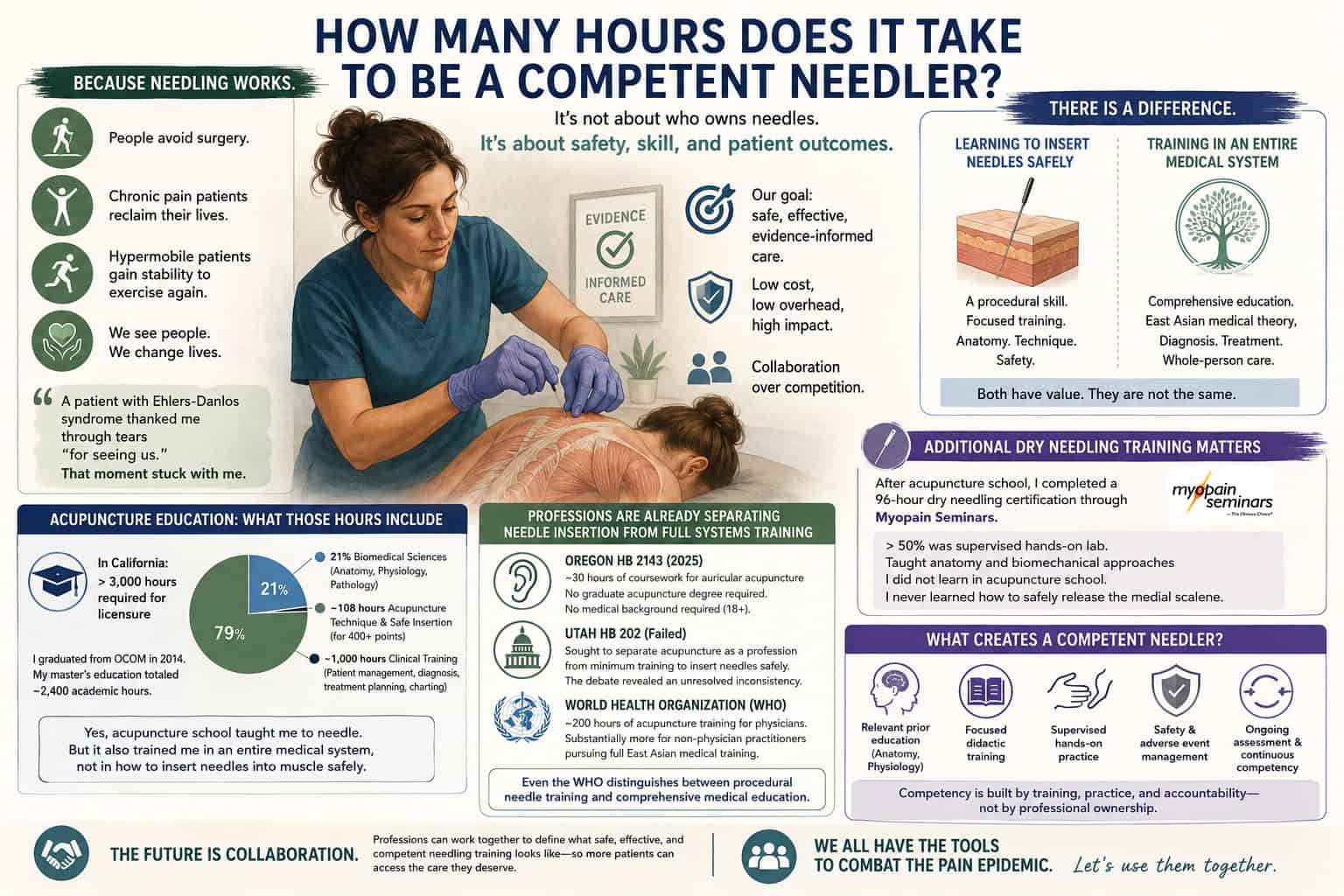
In private practice, I watch people avoid surgery. I watch chronic pain patients reclaim parts of their lives they thought were gone for good. I watch hypermobile patients finally feel stable enough to exercise again. Not long ago, a patient with Ehlers-Danlos syndrome thanked me through tears “for seeing us.” That moment stuck with me. I’m an acupuncturist who later trained in dry needling, and the work improves people’s lives.
Needling therapies are relatively low-cost, low-overhead interventions that can meaningfully improve pain and function. From my perspective, providers interested in patient outcomes should focus less on protecting professional territory and more on producing competent providers who can deliver effective, safe treatments.
The acupuncture profession itself is (finally!) discussing the same questions advocates of dry needling have asked for years: how many hours does it take to be a safe, competent needler?
The Educational Contradiction Behind Dry Needling Opposition
In Oregon, acupuncture leaders recently began discussing major changes to acupuncture education in response to the financial collapse facing many graduate medical programs. The Oregon College of Oriental Medicine, once considered one of the strongest acupuncture schools in the country, closed in 2024. Student debt, declining enrollment, and changes to federal loan access have forced my profession to confront uncomfortable realities.
Oregon acupuncture advocates want to restructure acupuncture education around competency-based training focused on safe needle insertion, point location, and basic medical literacy, while reducing educational hours. Some proposals even discuss eliminating clinical requirements entirely to obtain a degree.
That shift carries enormous implications, not just for acupuncturists, but for every profession involved in needling therapies.
For years, the acupuncture profession has argued that thousands of educational hours uniquely qualified acupuncturists to insert needles safely. Critics of dry needling legislation claim that dry needling “is acupuncture” and therefore should remain exclusive to licensed acupuncturists. In fact, this is one of the talking points acupuncture advocates in California are presenting to lawmakers to oppose Assembly Bill 2497. In California, becoming licensed as an acupuncturist currently requires more than 3,000 hours of formal education. The subcontext: fewer training hours pose a threat to public safety.
But here’s the uncomfortable part that acupuncturists ignore: not all of those hours involve needling.
I graduated from OCOM in 2014. My master’s education totaled roughly 2,400 academic hours. About 21 percent involved biomedical sciences such as anatomy, physiology, and pathology. Roughly 108 classroom hours focused specifically on acupuncture technique and safe insertion for more than 400 acupuncture points, the equivalent of approximately 4.5% of the total educational program. I also completed nearly 1,000 clinical hours in patient management, charting, diagnosis, and treatment planning, all rooted in Chinese medicine theory.
Yes, acupuncture school taught me to needle. But it also trained me in an entire medical system, not in how to insert needles safely into muscle contractures.
When Needling Becomes Separate From Acupuncture
Reviewing two pieces of recent legislation, introduced by the acupuncture profession itself, illustrates that acupuncturists themselves are starting to separate “safe needle insertion” from comprehensive East Asian medical education.
Last year, Oregon created a pathway allowing non-acupuncturists to perform auricular acupuncture after approximately 30 hours of coursework, known as Oregon House Bill 2143 (2025). Participants do not need graduate acupuncture education or an acupuncture licensure for this certification. Applicants do not need a medical background; the only prerequisite is being 18 years of age. Similar laws in 24 other states allow non-acupuncturists to perform this technique.
Utah’s recent House Bill 202 aimed to modify Utah’s Acupuncture Licensing Act by separating acupuncture as a profession from the minimum training hours necessary to insert needles safely. The bill ultimately failed, but the debate exposed a fatal flaw in the logic of acupuncturists opposing dry needling by other professions.
Even the World Health Organization has wrestled with who needs what training to insert the same needles. WHO guidance historically recommended roughly 200 hours of acupuncture training for physicians while recommending substantially more education for non-physician practitioners pursuing full East Asian medical training. The WHO itself distinguishes between procedural needle training and comprehensive medical-system education.
This is why the debate over dry needling in the acupuncture community feels so heated. There is a meaningful difference between learning how to insert needles safely and training in a medical framework.
Years after acupuncture school, I completed an additional 96-hour dry needling certification through Myopain Seminars, with more than half of that time spent in a supervised hands-on laboratory setting. That program taught me anatomy and biomechanical approaches I simply did not learn in acupuncture school. And for what it’s worth, I never learned how to safely needle the medial scalene during my acupuncture training.
I argue that sharing the needling technique with other professions doesn’t diminish acupuncture. It clarifies it.
The future of needling regulation cannot hinge on who claims ownership of acupuncture.
It hinges on whether the acupuncture profession, working alongside other healthcare professions, can define what safe and competent needle training actually looks like without turning the conversation into a shouting match. We all have the tools to combat the pain epidemic, so the hard part is over. Since acupuncturists are grappling with the same questions proponents of dry needling have presented for years, I’d argue that now is the perfect time for professions to collaborate on the exact requirements it takes for a practitioner to offer safe, effective needling procedures to the public.
Sarah Hammer Stevens, D.Ac., L.Ac., CMPT/DN, is a licensed acupuncturist in the state of Oregon and certified in dry needling through Myopain Seminars. She founded and directs To The Point PDX, an Oregon-based acupuncture and dry needling practice that focuses on evidence-informed pain care.