
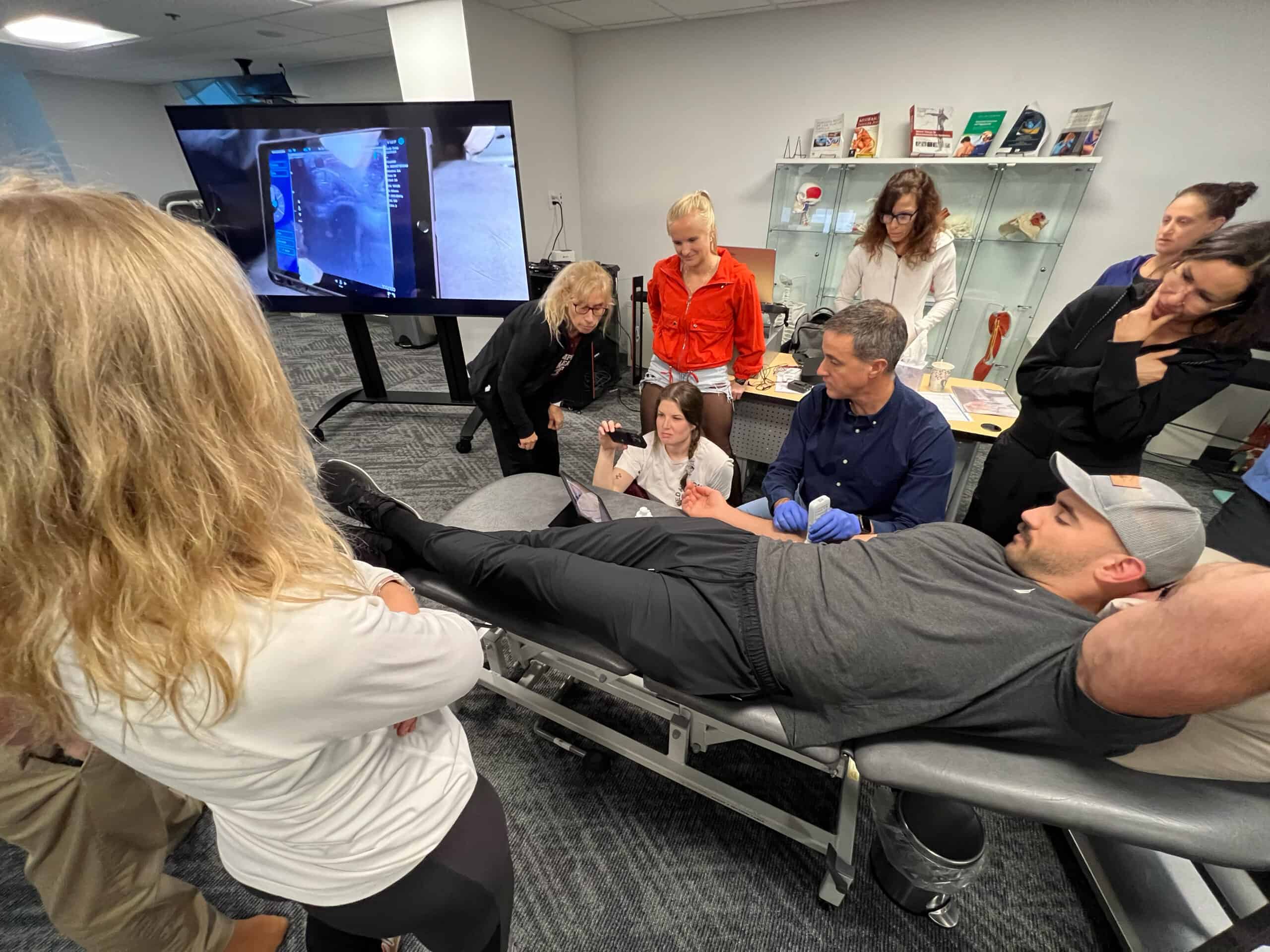
Spasticity remains one of the most challenging consequences of upper motor neuron lesions. Whether encountered after stroke, spinal cord injury, cerebral palsy, multiple sclerosis, traumatic brain injury, or other central nervous system disorders, increased muscle tone can interfere with almost every aspect of rehabilitation.
For physical therapists and occupational therapists, the consequences may include impaired gait, reduced balance, restricted joint mobility, difficulty with transfers, and diminished functional movement. Spasticity may limit reaching, grasping, and releasing objects, dressing, hygiene, positioning, splint tolerance, and other activities of daily living.
Traditional management commonly combines therapeutic exercise, positioning, stretching, orthoses, medications, botulinum toxin injections, and other rehabilitation strategies. Increasingly, however, dry needling is being investigated as another treatment option to reduce spasticity and create a window in which movement and function may be easier to retrain. Together with colleagues in Iran, Jan Dommerholt, president and CEO of Myopain Seminars, is actively involved in research exploring dry needling to reduce spasticity and understand possible mechanisms.
While the evidence is still developing, the findings are encouraging enough that PTs and OTs in neurological rehabilitation should pay attention.
Spasticity Is More Than “Tight Muscle”
Classically, spasticity refers to a velocity-dependent increase in stretch reflex activity associated with an upper motor neuron lesion. But resistance to movement can also include non-neural changes within muscles and connective tissues. Chronic hypertonicity and restricted movement may contribute to contractures, altered muscle architecture, increased stiffness, and reduced muscle fascicle length. Núñez-Cortés and colleagues emphasized the importance of distinguishing neural spasticity from tissue-related stiffness or hyper-resistance when interpreting clinical outcomes. Dry needling may potentially influence peripheral muscle properties and nervous-system activity, which may help explain why changes after dry needling have been reported not only in muscle tone, but also in range of motion, pain sensitivity, gait, balance, muscle architecture, and motor performance.
What Does the Clinical Evidence Show?
Most of the higher-level research has involved people following stroke.
A 2020 systematic review by Núñez-Cortés and colleagues included six randomized controlled trials involving 221 patients. Most muscles evaluated demonstrated significant reductions in spasticity following dry needling. However, the authors rated the certainty of the evidence as low, emphasizing small sample sizes, short follow-up periods, heterogeneous treatment protocols, and difficulties with participant and therapist blinding.
Dry needling can reduce post-stroke spasticity and improve passive ROM and pressure-pain sensitivity in the short term, but larger and better-controlled studies are still needed.
Salom-Moreno and colleagues randomized 34 patients with post-stroke spasticity to either a single session of deep dry needling of the gastrocnemius and tibialis anterior or no intervention. More patients who received dry needling showed reduced spasticity. They also showed bilateral increases in pressure-pain thresholds and changes in plantar-pressure distribution, including increased support surface and reduced mean pressure.
In another randomized clinical trial, Sánchez-Mila and colleagues compared Bobath-based rehabilitation with the same rehabilitation plus ultrasound-guided dry needling of the tibialis posterior. Significantly more patients receiving dry needling showed decreased spasticity. The dry-needling group also experienced greater improvements in selected Fugl-Meyer balance, sensory, and ROM domains and several measures of computerized dynamic posturography. Importantly, the authors acknowledged that some Fugl-Meyer improvements did not reach the minimum clinically important difference. This is a useful reminder that statistical improvement should not automatically equal meaningful functional change.
Muscle Architecture May Change Too
Hadi and colleagues studied six people with chronic stroke and ankle spasticity. After one session of dry needling to the gastrocnemius and soleus, resistance to passive movement decreased and Timed Up and Go performance improved.
Ultrasound revealed decreased gastrocnemius muscle thickness and pennation angle, while fascicle length increased. Although this small case series cannot establish a mechanism, it raises the possibility that dry needling may modify some of the non-neural physical characteristics of chronically hypertonic muscle.
Not Every Study Shows Reduced Spasticity
Mendigutia-Gómez and colleagues studied deep dry needling of several shoulder muscles as part of a post-stroke rehabilitation program. Dry needling produced significantly greater improvements in shoulder abduction, external rotation, and pressure-pain thresholds, but the investigators did not find a significant overall additional reduction in spasticity. Nevertheless, for an occupational therapist working to improve dressing, reaching, positioning, hygiene, or upper-extremity use, increased shoulder ROM and reduced pain sensitivity may be highly relevant outcomes. The study also showed that the Modified Ashworth and Modified Modified Ashworth (MMAS) scales measure resistance during passive movement but cannot fully separate reflex-mediated spasticity from mechanical stiffness, which is a limitation of the scales.
Could Dry Needling Affect the Central Nervous System?
Perhaps the most fascinating development in this literature is evidence suggesting that the effect may not be exclusively local.
In a post-stroke case studied with functional MRI, Mohammadpour and colleagues found that dry needling was followed by normalization of wrist-flexor MMAS score, a 10° increase in active wrist extension, improvement in hand recovery stage, and increased activation of primary motor, primary somatosensory, and supplementary motor cortical regions. The authors appropriately characterized these observations as preliminary. A single case cannot demonstrate that dry needling caused cortical reorganization. Nevertheless, the simultaneous clinical and imaging changes raise an important research question about neuromodulation following peripheral needling stimulation.
A 2024 case report by Ebrahimzadeh and colleagues extended this question using diffusion tensor imaging. After three dry-needling sessions in a patient following stroke, wrist-flexor MMAS decreased from 3 to 1, active wrist extension increased 12°, passive extension increased 16°, and Box and Block performance increased from 12 to 24 blocks. Measures of corticospinal tract fractional anisotropy also changed in a direction the authors interpreted as improved CST consistency.
Again, this is mechanistic hypothesis-generating evidence, not proof of neuroplasticity caused by dry needling. But it suggests that future dry-needling research in neurological rehabilitation should examine the intervention not merely as a method of mechanically treating muscle.
What Might Explain the Changes?
At present, no single mechanism adequately explains the observed effects, but several possibilities have been proposed.
Dry needling may mechanically influence shortened or contractured muscle fibers and alter actin-myosin overlap. It may change muscle stiffness or architecture. It may modify sensory input from muscle afferents and thereby influence spinal motor-neuron excitability. Local twitch responses may also affect spontaneous motor-endplate activity.
Central nervous system effects are also plausible. The fMRI and diffusion-tensor findings described above suggest that peripheral needling input may influence motor and sensory processing, although these mechanisms require much more rigorous investigation. In other words, dry needling in neurological rehabilitation may ultimately be best understood as a sensorimotor intervention rather than simply a treatment for a “tight muscle.”
Evidence Beyond Stroke
Although stroke dominates the literature, several case reports suggest that the potential application extends to other neurological populations.
In a patient with multiple sclerosis, one minute of hamstring dry needling reduced MMAS scores, reduced measured hamstring stiffness, and improved the Timed 25-Foot Walk from 16.30 to 9.29 seconds.
A patient with incomplete spinal cord injury who received dry needling over ten weeks showed reductions in upper- and lower-limb spasticity, improved dynamic stability, faster walking, decreased pain, and a 21-point improvement on the Spinal Cord Independence Measure. These findings are promising but derive from a single case.
Similarly, a patient with hemiplegia following brain-tumor surgery showed reduced wrist- and plantar-flexor MMAS scores, along with improvements in ankle and wrist ROM, Box and Block performance, Timed Up and Go, and single-leg stance after three dry-needling sessions.
The pediatric literature is even more preliminary. In a child with spastic quadriplegic cerebral palsy treated over an extended period with dry needling plus intramuscular electrical stimulation, passive ROM and caregiver-assistance outcomes improved, but MMAS and GMFCS classifications did not change.
That distinction matters for occupational therapists: functional gains and reduced caregiver burden may matter even when a conventional spasticity scale remains unchanged.
The Real Opportunity: Create a Window for Function
Dry needling should not be viewed as a stand-alone neurological rehabilitation program. Reducing resistance to movement for 10 minutes, several hours, or even several days has limited value unless the therapist uses that opportunity.
The more compelling clinical model is to use dry needling, when indicated, to create a temporary window in which movement is easier, and then immediately capitalize on that window with interventions such as:
- task-specific motor training;
- gait and balance training;
- strengthening through newly available ranges;
- reach, grasp, release, and manipulation activities;
- upper-extremity functional training;
- transfers and mobility;
- positioning and self-care activities; and
- caregiver training and meaningful activities of daily living.
This is where physical therapy and occupational therapy perspectives become especially complementary. The objective is not simply to make the muscle feel less resistant. The objective is to translate changes in tone, stiffness, pain, or ROM into better movement, participation, and independence.
Learning to Apply Dry Needling in Neurological Rehabilitation
Dry needling for spasticity is clearly an emerging, rather than fully established, intervention. Most studies remain small, outcomes are predominantly short-term, dosing protocols vary considerably, and the literature contains a mixture of randomized trials, case series, and case reports. A 2022 systematic review of invasive physiotherapy similarly concluded that these approaches appear promising when combined with conventional rehabilitation but emphasized treatment heterogeneity and the need for long-term studies.
That makes education, patient selection, clinical reasoning, and appropriate integration with rehabilitation particularly important.
Myopain Seminars offers a dedicated advanced course addressing this emerging application. The course is currently listed as Dry Needling for Neurological Disorders, a two-day, evidence-informed program focused on using dry needling to reduce spasticity. The current course catalog lists an upcoming program beginning October 31, 2026, in Bethesda, Maryland.
For physical therapists and occupational therapists who already use dry needling and want to expand their skills into neurological rehabilitation, this course offers an opportunity to move beyond traditional musculoskeletal applications and explore how to incorporate needling thoughtfully into the management of patients with upper motor neuron disorders.
Emerging evidence suggests the question is no longer simply, “Can dry needling reduce spasticity?” A more clinically relevant question may be:
If dry needling temporarily changes spasticity, stiffness, pain, sensory input, or available movement, how can we use that opportunity to help our patients move and function better?
That is where neurological dry needling becomes particularly relevant to both physical and occupational therapy.
Jan Dommerholt, PT, DPT | President/CEO, Myopain Seminars
References
- Núñez-Cortés R, Cruz-Montecinos C, Latorre-García R, Pérez-Alenda S, Torres-Castro R. Effectiveness of dry needling in the management of spasticity in patients post stroke. J Stroke Cerebrovasc Dis. 2020;29:105236. doi:10.1016/j.jstrokecerebrovasdis.2020.105236.
- Salom-Moreno J, Sánchez-Mila Z, Ortega-Santiago R, Palacios-Ceña M, Truyol-Domínguez S, Fernández-de-las-Peñas C. Changes in spasticity, widespread pressure pain sensitivity, and baropodometry after the application of dry needling in patients who have had a stroke: a randomized controlled trial. J Manipulative Physiol Ther. 2014;37:569–579. doi:10.1016/j.jmpt.2014.06.003.
- Mendigutia-Gómez A, Martín-Hernández C, Salom-Moreno J, Fernández-de-las-Peñas C. Effect of dry needling on spasticity, shoulder range of motion, and pressure pain sensitivity in patients with stroke: a crossover study. J Manipulative Physiol Ther. 2016;39:348–358. doi:10.1016/j.jmpt.2016.04.006.
- Sánchez-Mila Z, Salom-Moreno J, Fernández-de-las-Peñas C. Effects of dry needling on post-stroke spasticity, motor function and stability limits: a randomised clinical trial. Acupunct Med. 2018;36:358–366. doi:10.1136/acupmed-2017-011568.
- Hadi S, Khadijeh O, Hadian M, et al. The effect of dry needling on spasticity, gait and muscle architecture in patients with chronic stroke: a case series study. Top Stroke Rehabil. 2018;25(5):326–332. doi:10.1080/10749357.2018.1460946.
- Mohammadpour F, Oghabian MA, Ansari NN, Naghdi S, Dommerholt J. Effects of dry needling on post-stroke brain activity and muscle spasticity of the upper limb: a case report. Acupunct Med. 2021;39(1):69–71. doi:10.1177/0964528420920294.
- Ebrahimzadeh M, Ansari NN, Abdollahi I, Akhbari B, Dommerholt J. Changes in corticospinal tract consistency after dry needling in a stroke patient. Case Rep Neurol Med. 2024;2024:5115313. doi:10.1155/2024/5115313.
- Khalifeloo M, Naghdi S, Ansari NN, Dommerholt J, Sahraian MA. Dry needling for the treatment of muscle spasticity in a patient with multiple sclerosis: a case report. Physiother Theory Pract. 2022;38(13):3248–3254. doi:10.1080/09593985.2021.1978118.
- Cruz-Montecinos C, Núñez-Cortés R, Bruna-Melo T, et al. Dry needling technique decreases spasticity and improves general functioning in incomplete spinal cord injury: a case report. J Spinal Cord Med. 2020;43(3):414–418. doi:10.1080/10790268.2018.1533316.
- Tavakol Z, Shariat A, Ghannadi S, et al. The effect of dry needling on upper and lower limb spasticity in a patient with a brain tumor. Acupunct Med. 2019;37(2):133–135. doi:10.1177/0964528419830401.
- Okonski T, Dommerholt J. Dry needling with electrical stimulation for the treatment of a pediatric patient with spastic cerebral palsy: a case report. Explor Neuroprot Ther. 2022;2:242–255. doi:10.37349/ent.2022.00031.
- Javier-Ormazábal A, González-Platas M, González-Sierra E, González-Sierra M. Invasive physiotherapy as a treatment of spasticity: a systematic review. Degener Neurol Neuromuscul Dis. 2022;12:23–29. doi:10.2147/DNND.S350192.