
Maggie Gebhardt PT, DPT, OCS, FAAOMPT
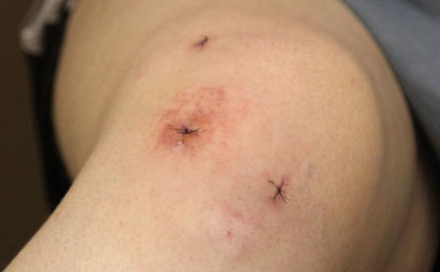
Have you ever been treating a patient who is post knee arthroscopy and everything is going well except that they are still having some medial knee discomfort towards the end of their plan of care? Upon exam, everything is normal, and you cannot find a reason for their continued discomfort. As with a traditional arthroscopic approach, there is usually an incision located inferior and medial to the patella, an instrument site. Well, perhaps consider that port site as the culprit?
Typically, that port site is right where the infrapatellar branch of the saphenous nerve is taking the turn to travel inferior to the patella. The saphenous nerve is sensory, so the only manifestation of it being impacted could be pain with no apparent motor deficits. There is a specific neural tension test to use as an objective measure, but other than that, it would be hard to identify it as the impacted structure specifically. However, once you identify a problem with the nerve, the question should be, “why?” Well, back to that port site…
As the scar tissue from the incision forms, sometimes sprouting off the saphenous nerve can become entrapped within the newly formed scar tissue, especially if the scar tissue is developing abnormally. These small entrapments can cause nerve-like pain sensations in the general vicinity of the saphenous nerve. You try some nerve gliding, but the glides will have minimal effects if the nerve is entrapped. You need to get that nerve “unstuck!”
Implementing the fascial and scar tissue techniques with needling introduced in Myopain’s DN-2 class should resolve any entrapments caused by scar tissue at the port site and allow the saphenous nerve to move freely. Over time, along with the restoration of normal neural mechanics, that patient’s pain should subside, allowing them to return to functioning freely!