

Have you ever treated the longus colli?
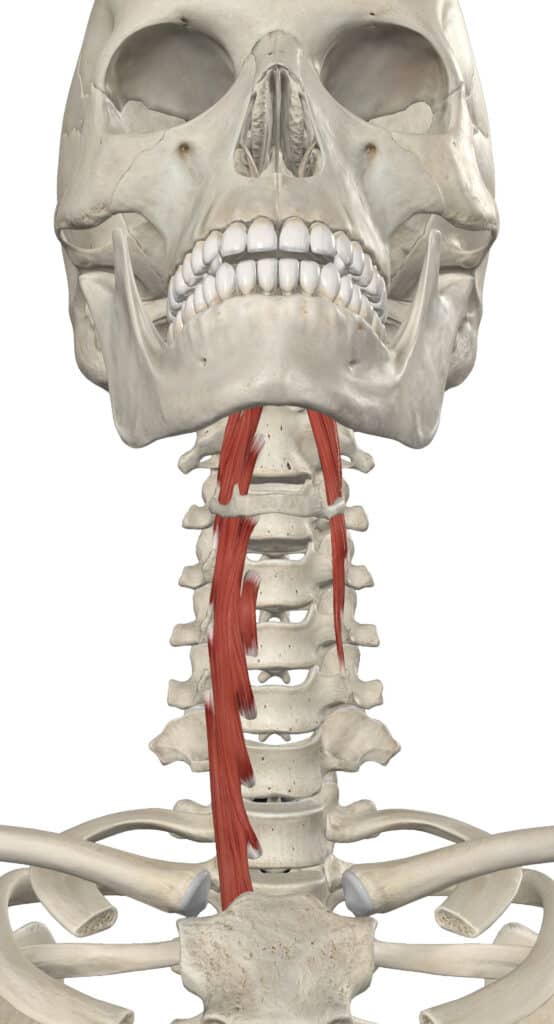
I was teaching how to needle this muscle in a level 3 dry needling course, and the volunteer for the demonstration said she had neck issues that had been ongoing for a few decades following a neck injury, with limited rotation.
She had been told that she had a lower cervical mobility issue, so I checked her supine active and passive cervical rotation, and she was missing about 30 degrees of rotation to the right.
To narrow it down, I performed the flexion-rotation test and found that the entire 30 degrees of restriction were coming from C1/2, not the lower cervical spine.
“Alright,” I said, “this muscle isn’t a rotational muscle, so I’m not expecting any change, but we’re practicing the longus colli, so let’s needle it and see if anything changes.”
I demonstrated how to needle the right muscle, and when we checked her range of motion afterward, it was normal for the first time in years. I was as surprised as she was.
A year or so later, I was seeing a patient for a shoulder injury that occurred while trying to put her arm into the sleeve of her coat. She was just reaching back, felt a twang, and then had weeks of pain. It seemed at first like a relatively straightforward rotator cuff issue, and she made good progress with 2 or 3 treatments focusing on trigger points in those muscles and the scapular stabilizers.
But it seemed like she could be making more progress; her active shoulder flexion and abduction range of motion was still only about 120 degrees, which was definitely better than the 30-40 degrees she started with when she first saw me. She was also hypermobile and began describing a strange sensation in her body that occurred when she moved her neck a certain way.
I referred her to a physiatrist who specializes in hypermobile patients, but I suspected that treating her longus colli might be effective. So I needled it.
Immediately after needling, she regained almost all of the shoulder flexion and abduction that she had lost, and she retained that progress without ever losing it.

What was going on?
My working hypothesis is that the student and the patient had some degree of upper cervical instability or proprioceptive deficit. The upper cervical spine plays a major role in how the brain interprets position and movement. Perhaps needling the longus colli provided enough input—or improved motor control—to change how the brain perceived stability, allowing normal movement to return?
There is not a lot of research on the functions of the longus colli muscle. There is even controversy over whether the muscle contributes to neck stability (1)! But if it does, it is conceivable that shoulder muscles may not function well with cervical instability and insufficient longus colli muscles. There are other such links, for example, between the masticatory muscles and the neck flexors. Co-contracting the masseter muscles increased the thickness of the longus colli muscle (2).
I’m not sure.
But now I’m always on the lookout for opportunities to try out this one weird neck trick.
Josh Lerner, L.Ac., CMTPT – Instructor
A few references
- Kennedy, E., M. Albert, and H. Nicholson, Do longus capitis and colli really stabilise the cervical spine? A study of their fascicular anatomy and peak force capabilities. Musculoskelet Sci Pract, 2017. 32: p. 104–113.
- Moon, H.J., B.O. Goo, and S.H. Cho, The effect of cocontraction of the masticatory muscles during neck stabilization exercises on thickness of the neck flexors. J Phys Ther Sci, 2015. 27(3): p. 659–61.