
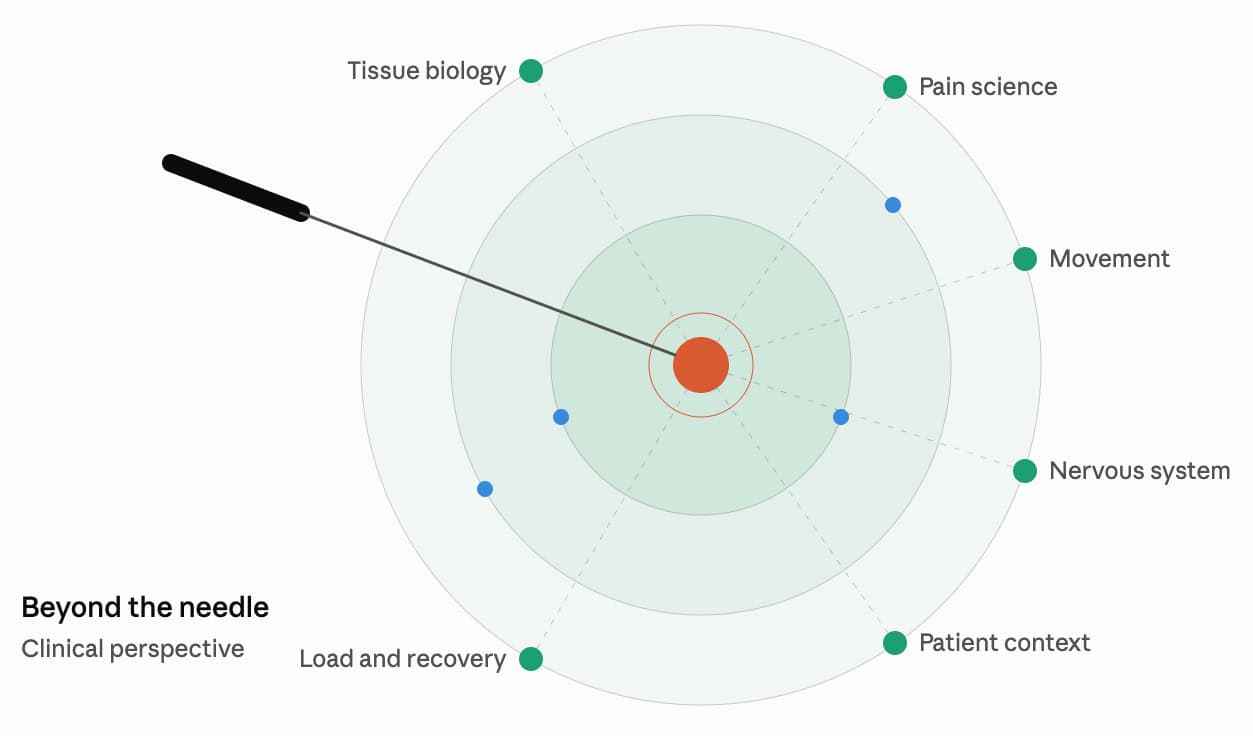
Dry needling is sometimes reduced to a deceptively simple idea: identify a painful muscle or myofascial trigger point, insert a needle, and attempt to change the tissue. But contemporary dry needling is much more than a needle technique.
Modern pain science reminds us that although a needle enters a muscle, the clinician is treating a person—not simply a trigger point. Effective dry needling requires an understanding of peripheral nociception, central pain processing, movement, patient expectations, communication, therapeutic context, and functional rehabilitation. For clinicians learning or practicing dry needling, this broader perspective fundamentally changes how they should use the intervention.
Persistent Pain Is More Than a Tissue Problem
Traditional biomedical thinking often assumes a relatively direct relationship between tissue pathology and symptoms. That model may work reasonably well for some acute conditions, but persistent musculoskeletal pain rarely behaves so predictably.
Contemporary rehabilitation therefore increasingly incorporates pain neuroscience education, graded activity, movement restoration, and consideration of psychological and social influences. The biopsychosocial model encourages clinicians to ask broader questions. How does pain affect the patient’s activities? Their confidence? Their work? Their relationships? Their goals?
At the same time, the biopsychosocial model should not become another rigid doctrine. Critics have noted that clinicians sometimes emphasize biological and cognitive factors while paying comparatively little attention to social, cultural, ethical, religious, and environmental influences.
The important message for dry needling clinicians is straightforward:
Do not replace an overly simplistic biomedical explanation with an equally simplistic biopsychosocial one.
Trigger Points Can Be Relevant Without Explaining Everything
Myofascial trigger points can provide persistent peripheral nociceptive input and may contribute to local pain, hyperalgesia, allodynia, secondary hyperalgesia, altered muscle activation, and potentially central sensitization, which makes them clinically relevant.
But telling a patient that a particular trigger point, disc, tendon, or other anatomical structure is entirely responsible for persistent pain can unintentionally reinforce fear and perceptions of bodily fragility. Language matters. Patients who repeatedly hear terms such as “degeneration,” “damage,” “tear,” or “slipped disc” may begin avoiding movement because they believe their body is vulnerable. Similar problems can arise if trigger points are portrayed as mysterious pathological knots that must continually be eliminated before the patient can function.
A more contemporary explanation is that trigger points may represent one source of nociceptive input within a much larger pain system. Dry needling can potentially modify that input without claiming that the entire pain experience originates within the muscle.
The Therapeutic Environment Is Part of the Treatment
Dry needling introduces another important variable: a needle is a potentially threatening stimulus, and the patient’s interpretation of that stimulus matters. When using an invasive procedure like dry needling, building a therapeutic environment based on trust, communication, realistic expectations, and self-efficacy is essential and can shape how treatment is experienced. A patient who understands why dry needling is being performed and feels safe with the clinician is approaching the treatment differently from someone who is anxious, uncertain, or expecting severe pain.
Although previous treatment experiences and patient expectations may also influence expectations, they did not significantly alter short-term outcomes after a single dry needling treatment for neck pain. Nevertheless, context cannot be separated completely from the intervention. The way dry needling is explained, introduced, performed, and followed up matters.
Think Bottom-Up and Top-Down
One of the most useful ways to conceptualize contemporary dry needling is to combine bottom-up and top-down treatment strategies. Dry needling is primarily a bottom-up intervention. It introduces sensory input through peripheral tissues and may alter local nociceptive, mechanical, biochemical, and neurophysiological processes.
Pain education, reassurance, expectations, attention, and behavioral strategies operate more from the top down. Neither should necessarily stand alone. Combining tissue-based interventions, such as dry needling, with pain neuroscience education and active rehabilitation may offer a more complete approach to persistent musculoskeletal pain. Clinically, this matters: if dry needling temporarily reduces pain or changes muscle activation, that improvement can create an opportunity to move. This creates an important clinical progression, whereby the needle should rarely be the endpoint.
Dry needling → reduce nociceptive input → move → restore confidence → restore function.
What Does Dry Needling Actually Do?
The precise mechanisms remain incompletely understood. Proposed mechanical effects include disrupting contracture knots and changing contracted sarcomeres. Dry needling may also influence motor endplates, spinal motor neuron excitability, muscle tone, and nociceptive processing. Local twitch responses can reduce abnormal endplate activity associated with trigger points.
Needling can also change the biochemical environment surrounding active trigger points. Researchers have documented alterations in substances associated with nociception and inflammation, along with increases in local blood flow and oxygen saturation, but more biochemical research is needed. The original NIH studies included only three subjects per study group, which precludes drawing significant conclusions. Furthermore, some findings appear dose-dependent, suggesting that more needling is not necessarily better. Excessive stimulation may potentially increase certain inflammatory mediators rather than reduce them.
That observation alone emphasizes why dry needling education must extend beyond simply learning where to place a needle.
What Should Contemporary Dry Needling Training Look Like?
Becoming proficient in dry needling requires anatomy, palpation skills, needle handling, safety, contraindications, and technical competency. But technical competency is only the beginning.
High-quality contemporary training should also help clinicians understand:
- pain neuroscience and sensitization;
- peripheral nociceptive mechanisms;
- trigger point physiology;
- therapeutic communication and expectation;
- appropriate treatment dosage;
- movement and motor-control implications;
- integration of dry needling with exercise and functional rehabilitation; and
- when not to needle.
This broader framework has long been central to Myopain Seminars’ educational philosophy. Dry needling should not be taught as a collection of isolated needling techniques or recipes for individual muscles. Clinicians need to understand why they are needling, what they hope to change, how those changes fit within contemporary pain science, and—most importantly—what comes next.
As Amna Alzaabi summarized in reaction to a lecture about dry needling in honor of World Physiotherapy Day,
A few takeaways from the World Physiotherapy Day 2026 webinar, “Dry Needling – The 2026 Update” with Dr. Jan Dommerholt that I found particularly relevant to clinical practice:
•More needles do not necessarily mean better treatment. Each needle should have a clear clinical and anatomical purpose.
•Knowing the target muscle is not enough for safe needling. Needle direction, depth, patient positioning, and the structures beyond the target all matter.
•Techniques should evolve with evidence. What we were taught previously should not automatically remain our current practice, particularly when new anatomical and safety evidence becomes available.
For me, the main takeaway was simple: “clinical reasoning should come before technique.” A valuable reminder to keep questioning, learning, and refining the way we practice.
The scientific evidence surrounding dry needling continues to expand, even as important questions about mechanisms remain unanswered. That uncertainty should encourage better education, not simpler explanations. Ultimately, the goal of dry needling is not to become exceptionally good at inserting needles. It is to become exceptionally good at using dry needling when appropriate, for the right reason, within a broader strategy designed to help patients move, function, and live better.
Jan Dommerholt, PT, DPT | President/CEO, Myopain Seminars
PS: This blog is based on a chapter in the upcoming third edition of our dry needling textbook:
Dommerholt, J. and Fernández-de-las-Peñas, C: Chapter 2 – A broad perspective of dry needling. In: Dommerholt, J. and Fernández-de-las-Peñas, C: Dry Needling: An Evidence and Clinical-Based Approach. Elsevier, 2026