
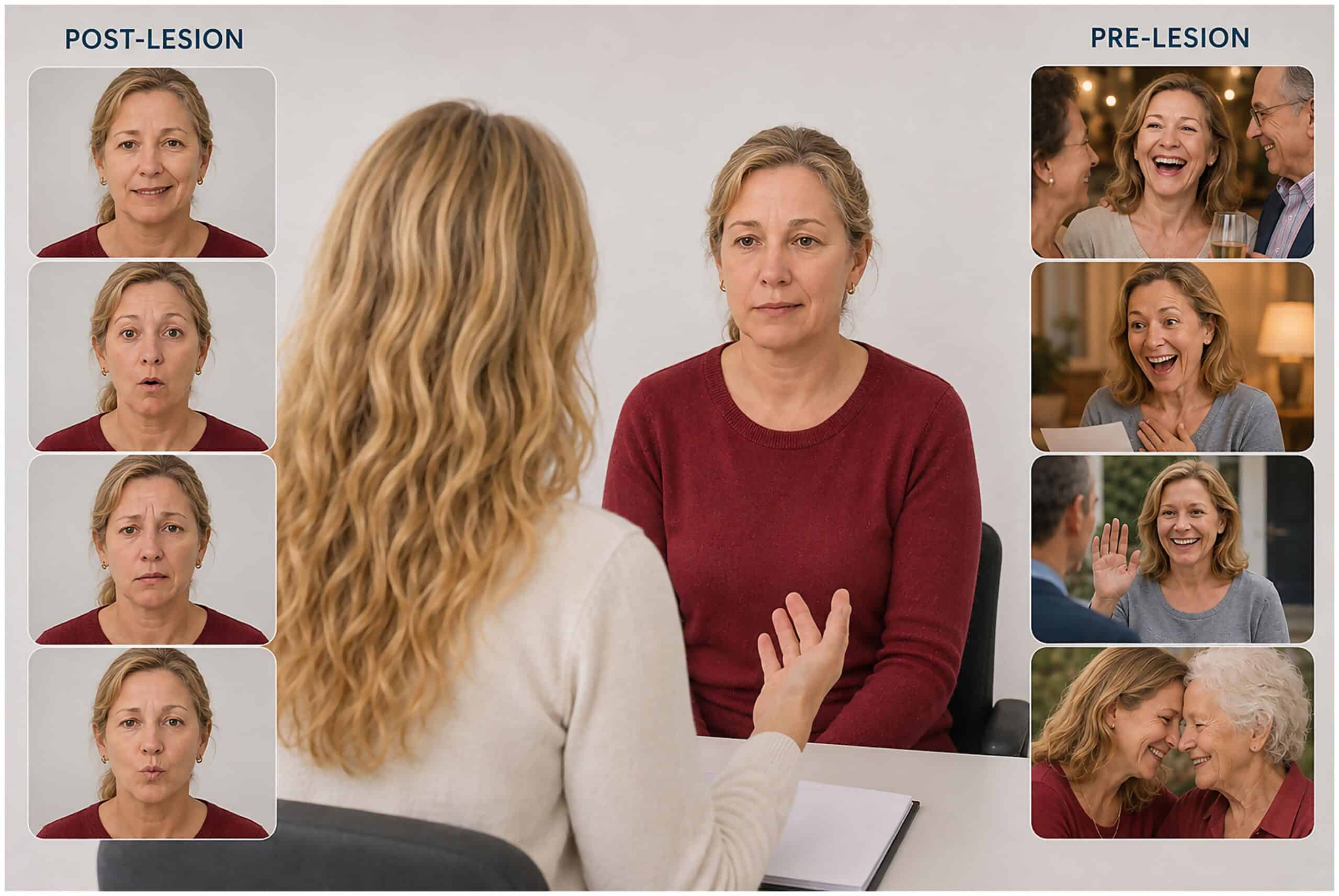
Starting in October 2026, the Cranial Facial Therapy Academy (CRAFTA) has completely reorganized its course program, as summarized in a recent blog. One of the main reasons we invite European course instructors to teach courses under the Myopain Seminars umbrella is that they often bring a different perspective than what’s commonly taught in the US, leading to new and innovative courses and, more importantly, improved clinical skills to better serve our patients.
In this blog, we highlight a new narrative review by von Piekartz, Kuttenreich, and Taxer—”Beyond motor recovery: emerging perspectives in the management of peripheral facial palsy—a narrative review”—that challenges clinicians to think more broadly about peripheral facial palsy (PFP). The perspectives are fully integrated into the “CRAFTA approach.”
Peripheral facial palsy (PFP) is often approached as a problem of facial muscle weakness. Physical therapy therefore traditionally focuses on restoring symmetry, improving voluntary movement, reducing stiffness, and managing synkinesis.
The authors argue that persistent problems following facial nerve injury cannot always be explained by peripheral motor dysfunction alone. Facial palsy may also affect somatosensory processing, body awareness, body image, emotional expression, and sensorimotor integration. Rehabilitation may therefore need to address not only how the face moves, but also how the patient perceives, experiences, and controls the face.
The Face Is More Than a Motor System
Facial expression emerges from a complex interaction among facial motor pathways, trigeminal sensory input, cortical sensorimotor networks, and brain regions involved in emotion and social communication. Following facial nerve injury, the brain receives altered information about facial movement. Even when conventional sensory testing appears normal, patients may describe the affected side as heavy, swollen, numb, foreign, or disconnected.
The review proposes that this apparent contradiction may reflect a sensorimotor mismatch rather than straightforward peripheral sensory loss. The patient’s intended facial movement, actual movement, and sensory experience no longer correspond accurately. Cortical reorganization following facial nerve palsy may further disrupt the internal representation of the face. This distinction matters clinically. A patient can recover substantial muscle activation and still report that the face does not feel normal.
Body Schema and Body Image Deserve Attention
The authors distinguish between body schema, the largely unconscious representation used to control movement, and body image, described as the conscious visual and emotional experience of one’s appearance.
Both may be altered in facial palsy. Patients can misjudge the amplitude, symmetry, or timing of facial movements while simultaneously experiencing distress about appearance, avoidance of mirrors, social withdrawal, or fear of negative evaluation. Because facial expression plays such an important role in communication and identity, these consequences can be substantial.
For physical therapists, this suggests that clinical success should not be defined exclusively by stronger facial contractions or better symmetry.
Assessment Should Become More Multidimensional
Traditional measures such as the House-Brackmann Grading System and Sunnybrook Facial Grading System remain valuable for documenting motor function and synkinesis. The Facial Disability Index adds information about physical and social function. However, these instruments do not fully examine altered facial perception or body representation.
The review therefore encourages clinicians and researchers to consider additional domains, including facial body awareness, tactile discrimination, motor imagery, emotional recognition, self-perception, and psychosocial distress. Potential approaches discussed include facial body scanning, two-point discrimination, laterality testing, facial emotion-recognition tasks, trigeminal blink-reflex assessment, and questionnaires addressing body image and facial awareness.
Combining “Hands-On” and “Hands-Off” Rehabilitation
One of the most clinically relevant themes is integrating traditional physical therapy with neurocognitive rehabilitation. Hands-on approaches may include tactile stimulation, stretching, manual techniques, and facilitated orofacial movement. Hands-off strategies can incorporate:
- mirror and EMG biofeedback
- structured facial movement training
- motor imagery and visualization
- laterality training
- sensory-discrimination exercises
- emotion-focused training
- mindful movement
- psychologically informed rehabilitation.
Early research provides intriguing examples. Mirror-based interventions have improved facial function and social participation. Tactile feedback using tape reduced oro-ocular synkinesis in a small controlled study, while computerized visual feedback showed immediate changes in muscle activation patterns. Psychological interventions have improved social functioning and appearance-related distress even without measurable improvement in facial motor function.
The authors organize this broader neurocognitive perspective within an 8-E model, intended to help clinicians systematically consider aspects of experience and sensorimotor processing that extend beyond isolated muscle performance.
The 8-E Model
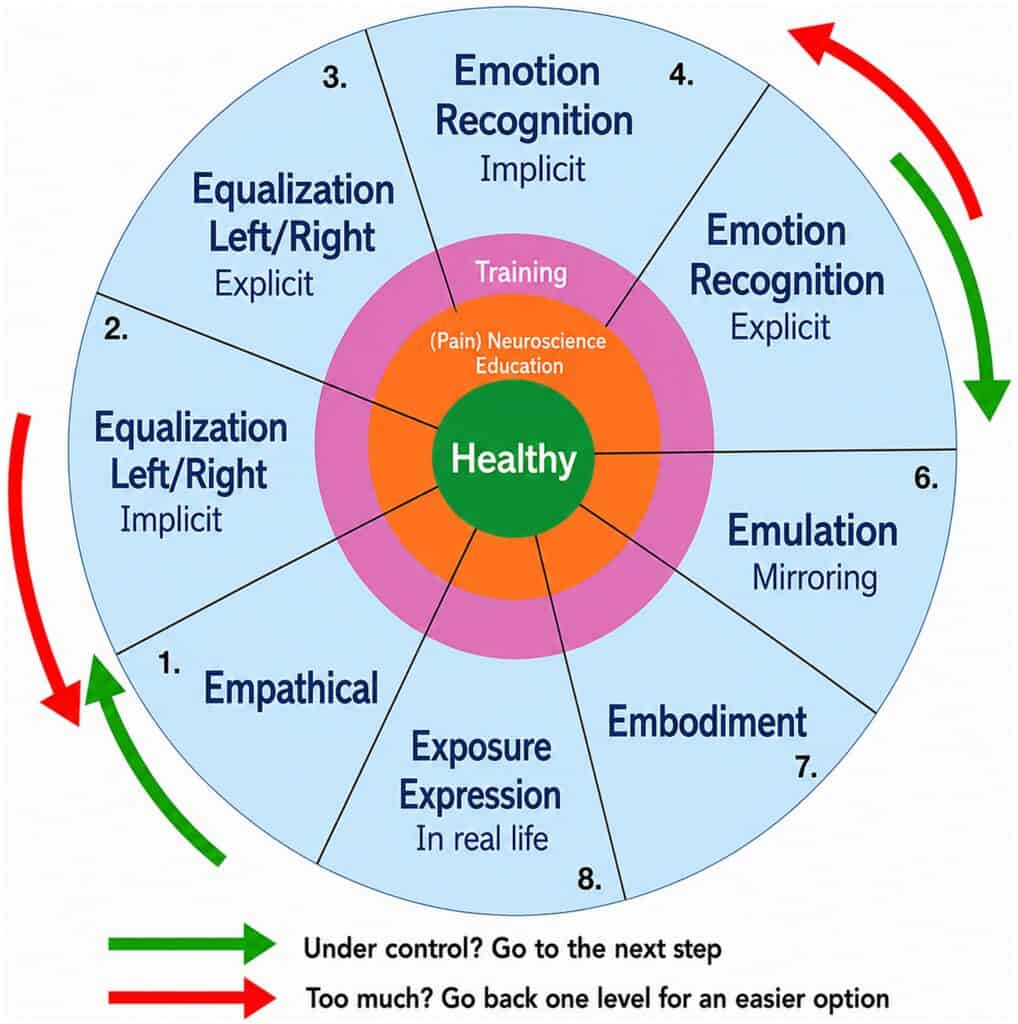
The 8-E model is one of the paper’s most clinically interesting elements because it reframes facial rehabilitation as a staged brain-training process, rather than simply a progression of facial strengthening or movement exercises.
It draws conceptually on graded motor imagery and is intended to address four broad goals:
- restoration of voluntary facial movement
- reduction of synkinesis and compensatory movement
- normalization of facial body schema/body image, and
- restoration of facial recognition and expression in real-world social situations.
The authors envision progression from implicit processing to explicit imagery, actual movement, emotionally meaningful expression, and ultimately functional social participation.
The eight stages are:
- Empathy — observation and visualization. The patient initially observes and imagines facial movements rather than attempting them immediately. Movements are organized from easier/less threatening movements to more difficult ones. The purpose is to reactivate facial motor representations while minimizing anxiety, avoidance, or excessive effort.
- Equalization (implicit) — laterality judgment. Patients rapidly determine whether facial images or expressions are biased toward the left or right side without actually performing the movement. This is intended to engage motor-planning networks implicitly and help recalibrate the cortical representation of the affected side of the face.
- Equalization (explicit) — motor visualization. The patient deliberately imagines performing facial movements, progressing from the less affected to the affected side and from simple movements to more complex expressions. Both first-person kinesthetic imagery and third-person visual imagery can be used. Importantly, this occurs before demanding actual movement, aiming to improve the motor representation without reinforcing compensatory or synkinetic patterns.
- Emotion Recognition (implicit). Attention then shifts from movement to the emotional meaning of facial expressions. Patients practice recognizing expressions such as joy, sadness, anger, disgust, fear, and surprise, beginning with those that are easiest to identify. No facial movement is required. The objective is to retrain the connection between facial perception, emotion, and internal motor simulation.
- Emotion Expression (explicit). Patients now deliberately produce those emotional expressions. Training progresses from expressions that are relatively easy to generate to those requiring more impaired muscle groups. The therapist may provide verbal instructions and gentle tactile assistance. A particularly important feature is that successful emotional communication does not require perfect facial symmetry—an important departure from rehabilitation focused primarily on cosmetic normalization.
- Emulation — action observation and mirror feedback. The patient observes and then attempts to reproduce movements performed by the therapist, a video model, or their own mirrored image. Mirror visual feedback can provide an artificially normalized visual representation of facial movement, potentially facilitating voluntary control and reducing synkinetic movement. Tasks progress from relatively simple movement imitation toward more complex emotional expressions.
- Embodiment — whole-body emotional expression. Rehabilitation expands beyond the face. Posture, gaze, gestures, and whole-body movements are incorporated because emotional communication is not solely facial. Rather than focusing excessively on how the affected muscles move, the patient is encouraged to adopt an external attentional focus—for example, on what an expression communicates to another person.
- Exposure — real-life social participation. Finally, the patient transfers these abilities into everyday life through graded exposure. Less challenging interactions may precede group conversations, work situations, video calls, or other contexts associated with facial self-consciousness. At this point the rehabilitation target is no longer simply facial movement; it is self-efficacy, communication, participation, and functional independence.
For physical therapists, the central idea is that the 8-E model progresses from perceiving → imagining → recognizing → expressing → imitating → embodying → participating. It shifts the endpoint of facial rehabilitation from simply producing a more symmetrical contraction to restoring the patient’s ability to experience, control, communicate with, and confidently use the face in meaningful social situations.
An Important Caution: The Evidence Is Still Emerging
The review should not be interpreted as proving that these newer approaches are superior to conventional facial rehabilitation. The evidence remains limited. Most available studies have small samples, short follow-up periods, and nonrandomized designs. Only a small number of conservative rehabilitation studies specifically address craniofacial body distortion and sensorimotor processing.
The authors therefore describe many of these interventions as promising rather than established. Larger, adequately powered randomized trials are needed before making firm clinical recommendations.
The Takeaway for Physical Therapists
Perhaps the most important message is conceptual: facial palsy should not automatically be reduced to facial muscle weakness.
For patients with persistent dysfunction, physical therapists may benefit from asking three questions:
How does the face move? How does the face feel? And how does the patient experience and use the face in everyday life?
A particularly important feature is the progression criterion. Patients do not simply advance because they can physically perform an exercise. They progress when the stage can be completed without significant anxiety, avoidance, or emotional distress. If mirror viewing, an expression, or another task produces substantial threat or avoidance, the therapist can reduce the difficulty or return to an earlier stage. The authors therefore replace the pain-based progression criteria traditionally associated with graded motor imagery with a concept of emotional safety.
Integrating those perspectives may move facial rehabilitation from simple motor restoration toward a more comprehensive form of sensorimotor, neurocognitive, and person-centered rehabilitation.
Jan Dommerholt | President/CEO, Myopain Seminars