
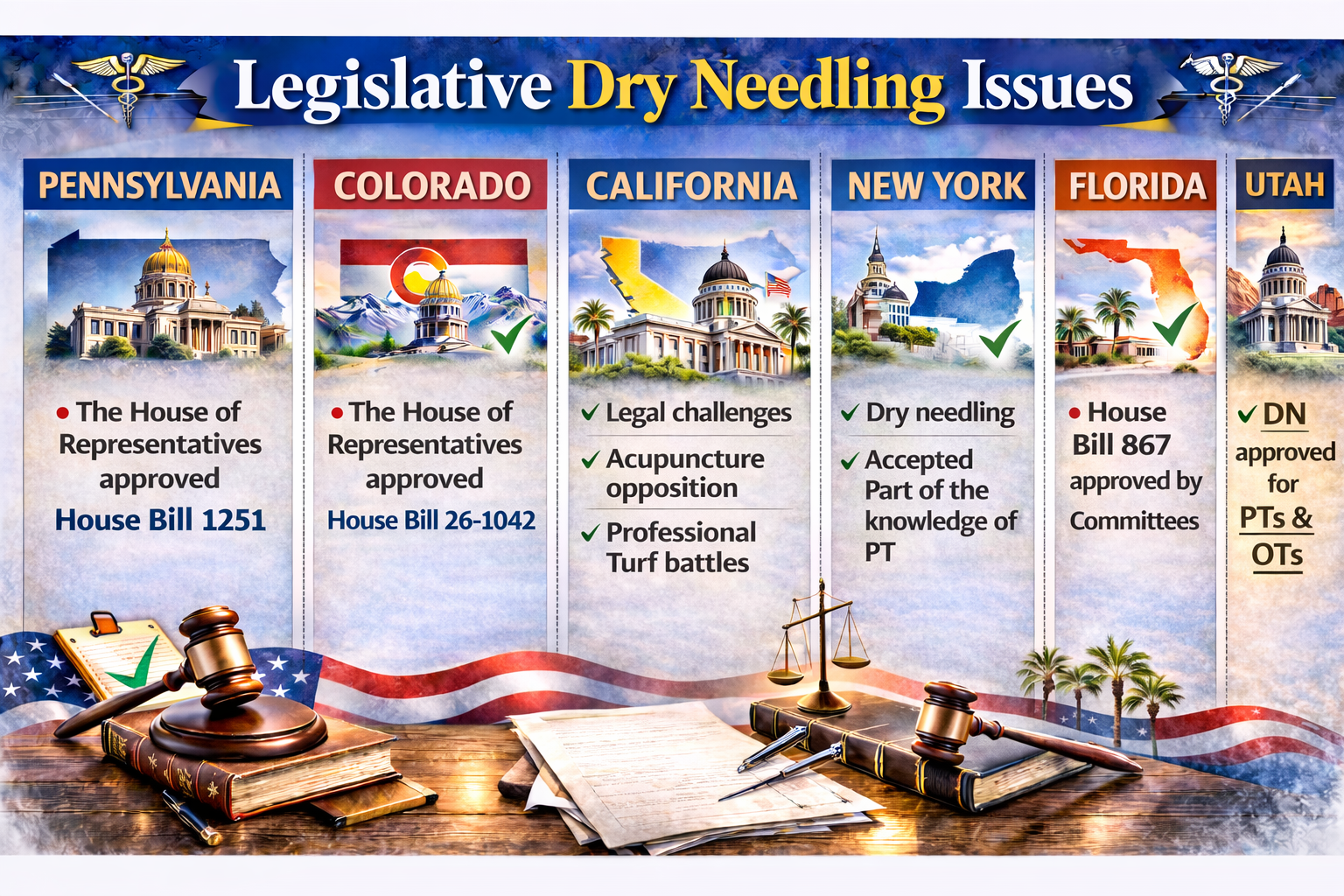
In this Legislative News Update, we report on exciting new developments in Utah, Pennsylvania, Colorado, and Florida, discuss the current state of affairs in California, and highlight opportunities in New York.
Utah
In May 2025, occupational therapists in Utah joined their physical therapy colleagues when dry needling became part of their scope of practice. According to H.B. 188 Dry Needling Amendments, a physical therapist or occupational therapist may practice trigger point dry needling if the therapist:
- has a valid license to practice occupational/physical therapy under this chapter
- has successfully completed a course in trigger point dry needling that is:(i)approved by the division; and(ii)at least 304 total course hours, including a minimum of:
- (A)54 hours of in-person instruction; and
- (B)250 supervised patient treatment hours
- files a certificate of completion of the course described in Subsection (1)(b) with the division
- registers with the division as a trigger point dry needling practitioner; and
- meets any other requirement to practice trigger point dry needling established by the division.
Pennsylvania
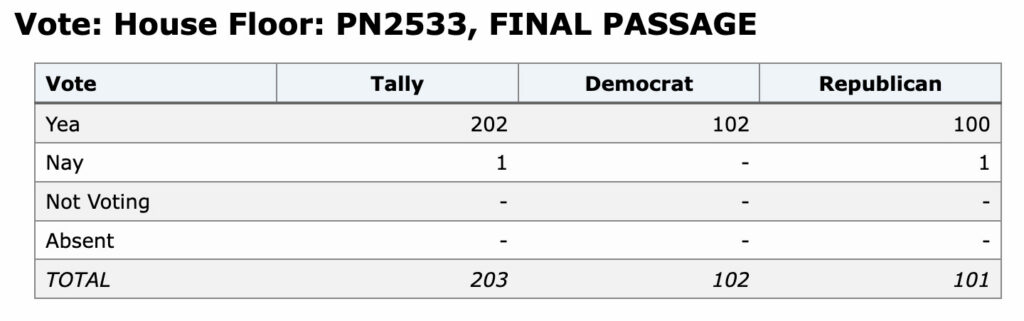
On December 17, 2025, the Pennsylvania House of Representatives overwhelmingly passed House Bill 1251, “Further providing for definitions and for practice of physical therapy.” The final passage included 202 yeas and only one nay.
On December 29, 2025, the Bill was referred to the Senate Consumer Protection & Professional Licensure Committee.
Colorado
On February 18, 2026, the Colorado House of Representatives unanimously approved House Bill 26-1042! In summary, the Bill authorizes an occupational therapist licensed in Colorado to perform dry needling on or after September 1, 2027, if the occupational therapist:
- Has the knowledge, skill, ability, and documented competency to perform the act;
- Has successfully completed a dry needling course of study that meets supervisorial, educational, and clinical prerequisites to be established by rule; and
- Obtains a written informed consent from each patient for dry needling, including information concerning the potential benefits and risks of dry needling.
The Bill is currently under consideration by the Colorado Senate.
California
On March 19, 2025, dry needling was one of the major agenda items on the annual meeting of the Physical Therapy Board of California. Representatives of the Federation of State Boards of Physical Therapy, the Veteran’s Administration, and individual physical therapists argued in favor of including dry needling into the scope of physical therapy in California. Mr. Niccolo De Luca, representing the California Acupuncture Coalition, which is a federation of California’s main acupuncture organizations, expressed that “in the spirit of collaboration and working together, we do feel strongly that dry needling is acupuncture, and any dry needling needs to be performed by a certified licensed acupuncturist,” because that “is in the best interest of the consumer.” He emphasized that acupuncturists “go through many, many, many, many years of training.” Reportedly, Mr. De Luca is an acupuncture lobbyist affiliated with the California State Oriental Medical Association (CSOMA).
In January 2024, the “preeminent professional associations within the field of acupuncture in California,” issued their “CA Acupuncture Profession Joint-Position Statement on Dry Needling in California.” Let’s have a close look at this position statement:
- Statement: “Current practice in states that allow “dry needling” by physical therapists do not meet the standards adopted by the AMA on Regulating Dry Needling.”
- Comment: It is not clear why the acupuncturists refer to the American Medical Association’s point of view. In 2019, Florida administrative judge the Honorable Lawrence P. Stevenson dismissed this argument, noting that only 18% of US physicians are members of the AMA, which implies that their opinions are irrelevant to this discussion. The AMA does not determine the scope of practice of any healthcare discipline.
Statement: “Current practice in states that allow “dry needling” by physical therapists violate the FDA’s statement regarding the sale of acupuncture needles.”
Comment: The acupuncturists cite a 1996 statement of the Federal Register, which does not state that the sale of acupuncturists would be limited to acupuncturists.
The FDA leaves that decision to individual states.
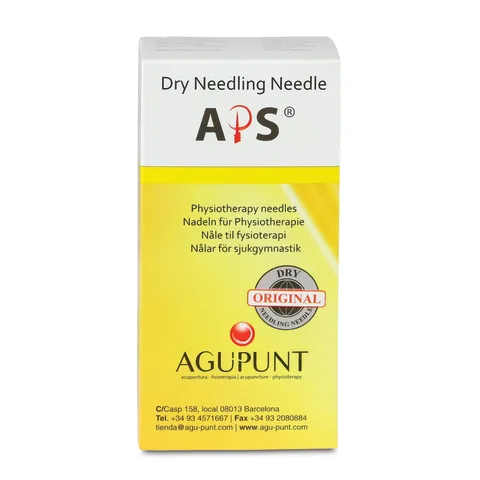
Furthermore, more recently, as part of its post-market regulations, the FDA has approved APS needles (Agupunt, Barcelona) for marketing and sale as “dry needling needles” and “Physiotherapy Needles,” without establishing or limiting who can purchase them.
- Statement: ““Dry needling” as it is currently practiced by physical therapists in other states, poses a hazard to public safety due to inherent risks of under-trained and unregulated practitioners.”
- Comment: The scare tactic of suggesting that dry needling would pose a public health risk has been refuted in every state that has approved dry needling by physical therapists. Furthermore, multiple adverse event studies have shown that dry needling by physical therapists is safe.
- Statement: “Dry needling” is now being practiced in California illegally in most major CA Universities and institutions by Athletic Trainers, and Physical Therapists.”
- Comment: To the best of our knowledge, not a single university in California offers courses in dry needling. Interestingly, the acupuncturists did not provide any supporting documentation for this statement. It is true that in other states, universities do include instruction in dry needling, ranging from brief statements to full courses. For example, Regis University (Denver) and Emory University (Atlanta) offer dry needling courses to their Doctor of Physical Therapy students.
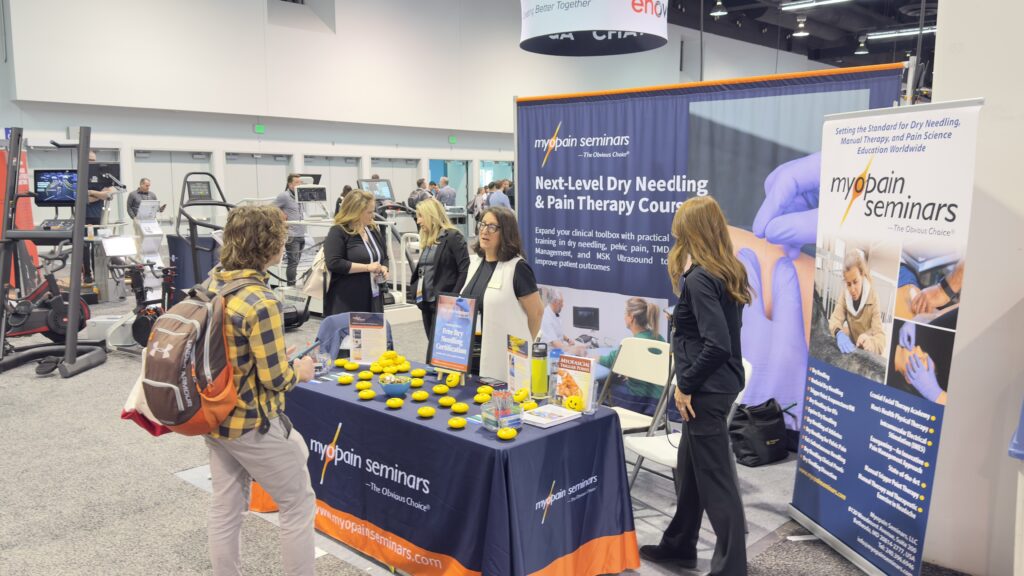
During the recent APTA-CSM conference in Anaheim, CA, many California-based physical therapists came by the Myopain Seminars booth to ask about dry needling. Several expressed concerns about the California acupuncture lobby, but as outlined above, the acupuncture lobby has offered no substantial arguments against adding dry needling to the scope of other healthcare providers, including physical therapists, occupational therapists, chiropractors, and athletic trainers.
I have testified on behalf of many physical state boards and APTA chapters, and I do not see any convincing reason why physical therapists in California would not be able to accomplish the same as nearly all other states in the country.
New York
In 1991, the New York State Board of Physical Therapy approved dry needling by physical therapists. Dr. Mark Seem, a prominent acupuncturist in New York, published an article in the July issue of Empire State Physical Therapy (a publication of the New York Physical Therapy Association) about “Trigger Point Needling for Physical Therapists” together with Drs. Finando and Weisberg, and they considered dry needling as a new opportunity for physical therapists.
A few months later, in October 1991, Henry A. Fernandez, Deputy Commissioner of the Professions, wrote a letter to the Editor clarifying the Education Department’s position. In that letter, he accused the Acting Executive Secretary for Physical Therapy of expressing an opinion prematurely. Instead, he reiterated that “determinations of modalities falling in or outside the scope of practice of the professions remain the responsibility of the State Education Department.” Mr. Fernandez did confirm that Touro College was allowed to teach dry needling as a concept; however, it was not considered “a modality to be practiced by licensees on a routine basis.”
In December 1991, our colleagues Dimitrios Kostopoulos and Konstatine Rizopoulos prepared a letter they submitted to the Deputy Commissioner of Professions to “re-establish dry needling as a legitimate physical therapy modality” with signatures of a number of physical therapists.
Unfortunately, on April 27, 1992, Mr. Fernandez issued a formal ruling from the State Education Department that dry needling, or more generically, the use of an invasive modality, would not fall within the scope of practice of physical therapy in New York. Its use had not been “authorized in the physical therapy law.”
Upon further analysis of this 1992 historic document, Mr. Fernandez did offer some guidelines for future appeals. He stated specifically that
the portion of the definition which refers to treatment by “mechanical means”, in our judgment, would allow for the possibility that dry trigger point needling could become recognized as a part of physical therapy practice in the future.
A legislative amendment giving explicit authority for use of the technique would be desirable.
However, the profession of physical therapy must demonstrate that dry trigger point needling has evolved to become an accepted part of the body of knowledge of physical therapy as evidenced by its inclusion within the systematic training offered in academic programs.
In 2007, Claudia Alexander, Executive Secretary of the State Education Department, opined that the criteria established by Mr. Fernandez had not been met in response to a letter by Mr. Kostopoulos.
However, it would seem that in 2026, all criteria for future consideration have been met. Dry needling has become an accepted part of the body of knowledge of the physical therapy profession. It is taught across academic programs in nearly the entire country (except perhaps California and New York).
The American Physical Therapy Association considers dry needling to be within the scope of PT Practice. The Healthcare Regulatory Research Institute (HRRI), in partnership with the Federation of State Boards of Physical Therapists (FSBPT) and the Human Resources Research Organization (HumRRO), conducted two studies of dry needling competencies. The most recent report, “Dry Needling Competency Update: Report Memo 2024,″ was released on October 24, 2024.
It is now up to physical therapists in New York State to petition the State Department of Education to allow citizens of the Empire State to receive dry needling from physical therapists.
Florida
Hot off the Press: Florida House Bill 867 was approved by Committees of the House of Representatives and is scheduled to go for a full vote in the House on February 25. After both the Florida House and Senate approve the Bill, occupational therapists in Florida can use dry needling starting on July 1, 2026.
According to the Bill, the Occupational Therapy Board must establish minimum standards of practice for the performance of dry needling, including
- Completion of 2 years of licensed practice as an occupational therapist.
- Completion of 50 hours of face-to-face continuing education from an entity approved by the board on the topic of dry needling, which must include a determination by the instructor that the occupational therapist demonstrates the requisite psychomotor skills needed to safely perform dry needling.
We will monitor developments in the Florida Senate and share any news in an upcoming Legislative News!